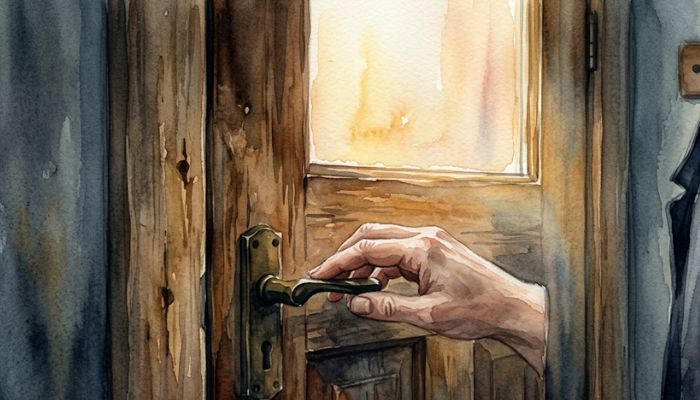
He prays the same prayer seven times every morning before he can leave the house. Not because he wants to. Because if he does not, something terrible will happen to the people he loves. He knows, theologically, that this is not how God works. He has read the verses. He has heard the sermons on grace and freedom, and he believes them. And he still cannot leave the house until the prayer is finished, counted, completed in exactly the right way. He has never told his pastor. He has never told anyone at church. Because in a community where prayer is the very language of faith, he does not know how to explain that his prayers have become a prison.
This is the fifth in a series on "What the Church Needs to Know about Mental Health".
Of all the conditions in this series, OCD carries the heaviest burden of trivialisation. It has become a casual adjective. People describe a preference for an organised desk or a colour-coded wardrobe as being "a bit OCD." That trivialisation is not harmless. It buries the reality of a condition that, for many people, is genuinely disabling, and it makes it much harder for those living with it to be believed when they finally try to describe what is actually happening to them.
Obsessive Compulsive Disorder has two interlocking features.
The first is obsessions. Intrusive, unwanted thoughts, images, or impulses that arrive without invitation and cause real distress. These are not daydreams or chosen ruminations. They are thoughts the person does not want and cannot stop, and they often directly contradict the person's values, their faith, and their sense of who they are. A devoted parent tormented by intrusive thoughts of harming their child. A faithful Christian assaulted by blasphemous images during worship. A gentle person haunted by violent thoughts they find repulsive.
The second feature is compulsions. Repetitive behaviours or mental acts performed in response to the obsession, to reduce the distress or prevent a feared outcome. Checking. Counting. Washing. Repeating. Praying in a precise sequence. Seeking reassurance. The compulsion gives temporary relief. The distress returns. The compulsion is performed again. Over time, the loop tightens. See accompanying infographic.
.jpg)
OCD is not a personality quirk or a preference for order. It is a condition in which the mind generates threats that reason cannot extinguish, and the person builds elaborate systems of behaviour to manage a dread that never fully resolves.
The church has two default responses to OCD, and both cause harm.
The first is trivialisation. Because the word has been so thoroughly absorbed into casual speech, many Christians do not recognise OCD as serious when they meet it. The person describing intrusive thoughts or repetitive rituals gets gentle humour, advice about decluttering, or a mild encouragement to trust God more. The severity of what they are describing does not register, and they leave feeling unseen and far less likely to try disclosing again.
The second response is spiritualisation, and it is more damaging. When the intrusive thoughts are blasphemous or violent in content, as they frequently are in what is sometimes called scrupulosity or religious OCD, the church is especially prone to reading them as spiritual attack, demonic influence, or evidence of hidden sin. This is catastrophic for one specific reason: reassurance-seeking is itself a compulsion. When a pastor prays over someone with OCD and tells them the intrusive thoughts are from the enemy and must be rebuked, they are feeding the exact mechanism that keeps the condition entrenched. The person performs the spiritual compulsion, feels a moment of relief, and the thoughts return with greater force. The loop tightens.
This is the counterintuitive heart of the matter. With OCD, the reassurance that feels like compassion is the thing that strengthens the disorder. The most loving response is not more reassurance. It is help getting to someone who can treat the loop itself.
There is a particular cruelty in the way religious OCD targets the things a person holds most sacred. Their faith, their love for God, their moral integrity become the content of the intrusions precisely because they matter so much. The thought is most distressing when it violates what the person most deeply values. That is not evidence of spiritual compromise. It is evidence of how OCD works. It attacks the sacred because the sacred is where the person is most vulnerable to dread.
The theological heart of OCD, the place where sound theology and sound clinical practice converge most clearly, is grace that is not contingent on performance.
OCD is, in part, a disorder of uncertainty. The compulsion is an attempt to reach certainty, to be sure enough that the door is locked, the prayer is complete, the thought has been rebuked thoroughly enough. But the certainty never fully arrives. The checking, the counting, the repeating, none of it delivers the assurance the person is chasing. The loop continues because the goal is unreachable by design.
The gospel speaks straight into this. Grace is not contingent on the prayer being prayed correctly. Acceptance is not conditional on the ritual being completed. The presence of God is not secured by the right words in the right sequence said the right number of times. The love of God in Christ is not a reward for adequate performance. It arrives before the performance begins and remains after it ends.
Neither death nor life, neither angels nor demons, neither the present nor the future, nor any powers, neither height nor depth, nor anything else in all creation, will be able to separate us from the love of God that is in Christ Jesus our Lord (Romans 8:38-39). Nothing, not even the most intrusive and distressing thought a mind can generate, can move a person outside the reach of that love. The blasphemous image, the violent impulse, the thought a person finds most repulsive and shameful, none of it relocates them beyond grace.
This truth has to be held carefully, because for someone with OCD even a beautiful verse can be turned into a compulsion, recited over and over for the brief relief it gives. So this is not a sentence to be deployed as a quick reassurance. It is a reality to be absorbed slowly, over time, alongside professional support, until it begins to do its deeper work in a place the counting could never reach.
If you are living with OCD. The thoughts are not you. The most distressing intrusive thought you experience is not a reflection of your character, your faith, or your standing before God. OCD attacks what matters most to you precisely because it matters most. A blasphemous thought during worship is not evidence that you are blasphemous; it is evidence that your faith is the thing you hold most sacred. You deserve professional support from a therapist trained in Exposure and Response Prevention, the evidence-based treatment for OCD. You also deserve a church that understands enough not to make it worse. Both are possible, and neither requires you to perform your way to certainty first.
If you are supporting someone with OCD. The hardest thing to understand is that reassurance makes OCD worse. When someone with OCD asks you to confirm that the door is locked, that the prayer counted, that the thought does not mean what they fear, and you give that reassurance, you reduce their distress for a moment and strengthen the condition for the long term. This is not intuitive, and it feels unkind to withhold comfort from someone visibly suffering. But the kindest thing you can do over time is to gently decline to feed the loop and to keep encouraging professional support. Learn what ERP therapy involves. Expect that recovery will not be linear. Be consistent, patient, and resistant to the strong pull to fix what reassurance cannot fix.
If you are a pastor or church leader. Two things matter most. The first is knowing enough about OCD to recognise it when someone describes their experience, and resisting the instinct to respond with prayer ministry as though the intrusive thoughts were a spiritual problem needing spiritual correction. The second is building a culture where scrupulosity and religious OCD can be named without shame. There are people in your congregation whose faith has become the main content of their obsessions. They are praying compulsively, confessing repetitively, seeking reassurance constantly, and growing more entrenched rather than more free. They need a pastor who knows enough to say, gently: this sounds like something a professional needs to help you with, and that referral is not a failure of faith. It may be one of the most pastorally precise things you ever offer them.
***
He finishes the seventh prayer. He checks the door. He starts again, because it did not feel right the first time. He is going to be late for church. He knows God's grace does not require any of this. He has known it for years.
The knowing and the doing are two different things when you are living inside the loop, and knowing the theology does not unlock the door. What unlocks it, slowly and imperfectly and over a long time, is professional support, a community that neither feeds the compulsion nor trivialises the condition, and the slow absorption of a grace that arrives before the ritual is complete and stays long after the counting stops. That grace is real. The church should be one of the places it is most visible. It is not always. It can be.
Part 1 – Depression
Part 2 – Anxiety
Part 3 – Bipolar Disorder
Part 4 – Schizophrenia
Part 5 – OCD
Part 6 – PTSD
Part 7 – Psychosis