He was the most gifted person in the room, and everyone said so. He led worship with an intensity that moved people to tears. He preached with a clarity that felt prophetic. He served with an energy that left everyone around him quietly wondering why they were not doing more. And then, without warning, he would disappear. Weeks would pass. He would resurface quieter, slower, harder to reach, the gifts still there but something behind his eyes gone flat. The church did not know what to do with either version of him. They celebrated the high. They waited out the low, assuming it was a dry season, a spiritual battle he would eventually win. Nobody named what it actually was, because nobody knew how.
This is the third in a series on "What the Church Needs to Know about Mental Health".
Bipolar disorder is a condition of extremes, and the word mood is far too small for it.
It moves between two poles. Mania or hypomania at one end, depression at the other. These are not the highs and lows everyone experiences over an ordinary week. They are distinct neurological states that change how a person thinks, perceives, decides, and functions, sometimes for days, sometimes for weeks, sometimes for months at a stretch. See the following infographic.
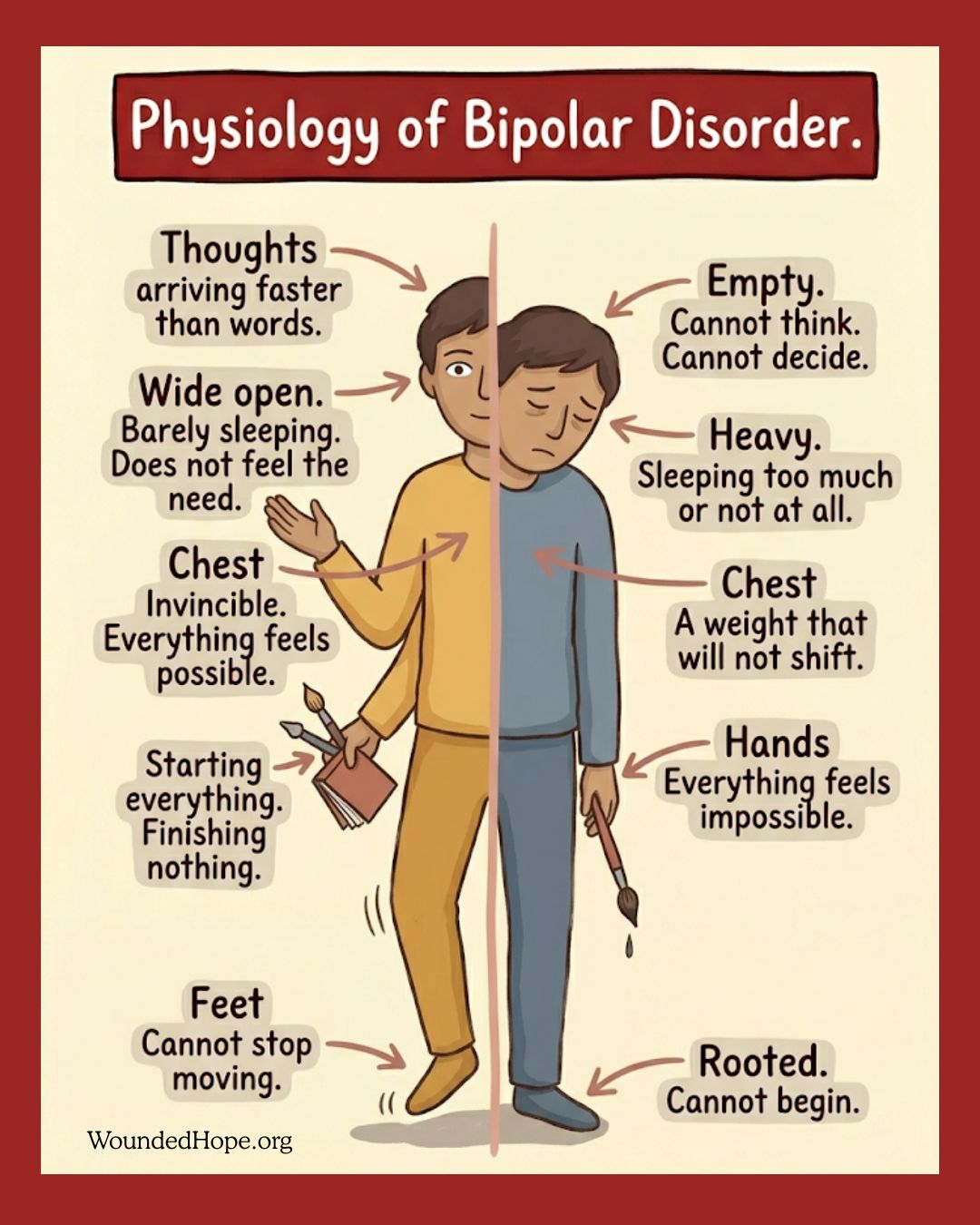
During a manic or hypomanic episode, the brain accelerates. Thoughts arrive faster than words can carry them. Sleep starts to feel unnecessary. Confidence swells past its usual edges. Decisions that should take weeks get made in minutes. Energy seems limitless, and everything feels possible. From the outside, this can look like inspiration, giftedness, even anointing. From the inside, it is often a state the person cannot fully steer, and the choices made inside it frequently carry consequences that outlast the episode by years.
During a depressive episode, the same brain slows to a crawl. The energy vanishes. The confidence collapses. The person who was leading worship two weeks ago cannot get out of bed. The clarity that felt prophetic has gone completely silent.
Between the two poles there are periods of stability, but the cycling continues. This is not a phase. It is not a spiritual season. It is a lifelong condition that requires ongoing management, professional support, and, in many cases, medication. And in a great many churches, it is profoundly misunderstood.
The charismatic and evangelical church is especially vulnerable to misreading bipolar disorder, because the manic phase can look, from the outside, like the moving of the Spirit.
Heightened energy. Expansive vision. Bold proclamation. A reduced need for sleep. A sense of divine urgency. These are qualities the church has historically prized in its leaders and prophets. When they show up in a person with undiagnosed bipolar disorder, the church tends to read them theologically rather than medically. The leader is celebrated, platformed, held up as a model of zeal, at the precise moment they may be least well.
This does two specific kinds of harm.
The first is that the high gets spiritualised and the low gets pathologised. The manic phase is welcomed as anointing. The depressive phase is treated as backsliding, or spiritual attack, or a failure of faith. The person learns very quickly which version of themselves the church wants. So they perform the high and hide the low, which is the exact opposite of what staying well requires. A church that only loves one pole teaches the sufferer to conceal the other, and concealment is dangerous in a condition this serious.
The second harm is relational, and it is the one the platform never sees. Bipolar disorder at its most acute can fracture marriages, strain children, unravel finances, and end careers. The cycling is not only an internal experience. It moves through a household like weather. Spouses carry the weight of the unpredictability. Children grow up learning to read the emotional climate of a parent before they decide whether to come into the room. Families absorb consequences they did not cause and cannot control. When the church sees only the gifted leader on the platform and never the family bearing the cost at home, it becomes part of a silence that protects the public self at the expense of the private one.
Bipolar disorder is not a spiritual gift with an unfortunate side effect. It is a medical condition that needs honest naming, real treatment, and a community willing to hold both poles with equal grace.
In Mark 5, Jesus meets a man living among the tombs. The description is harrowing. He is isolated, uncontrollable, harming himself, living in the place reserved for the dead. The townspeople had tried to restrain him with chains, and it had not worked. He had broken every one of them. His suffering had carried him entirely out of community and out of himself.
After the encounter with Jesus, the man is found sitting there, clothed and in his right mind (Mark 5:15). The phrase translated "in his right mind" is sōphroneō, meaning to be of sound mind, to think clearly, to be restored to oneself. It is the language of someone returned from a place their own mind had taken them without their consent.
This is not a one-to-one diagnosis of bipolar disorder, and it would be careless to treat it as one. But it is a biblical picture of what it means to be restored to oneself after a mind has carried a person beyond their own boundaries. And one detail repays close attention. The townspeople, when they see the man restored, are afraid (Mark 5:15). They had accommodated the disorder for years. The wholeness unsettled them. They actually ask Jesus to leave.
That is worth sitting with. Sometimes a community is more comfortable with a familiar, managed dysfunction than with the slower, messier, less dramatic work of genuine recovery. The restored man is harder to categorise than the man among the tombs was.
Notice, too, what the biblical response is not. It is not spiritual warfare followed by a platform ministry built on the dramatic testimony. It is restoration to community, to self, and to ordinary life. The man asks to follow Jesus, and Jesus sends him home, to his own people, to tell them what God has done (Mark 5:19). The shape of the hope is a return to the ordinary, not an elevation to the spectacular. That is the shape faithful response takes for the person with bipolar disorder too.
If you are living with bipolar disorder. You are not two people. The high and the low are both you, and neither one is the whole of you. Your gifts are real, and they do not need a manic episode to be valid. Your depression does not cancel your calling. The work of managing this faithfully, taking the medication, keeping the appointments, holding the rhythms, telling the truth to the people closest to you, is not a lesser form of faith. It is one of the most disciplined and courageous kinds of stewardship there is. You are allowed to be known in both poles. You do not have to perform the high for anyone's comfort.
If you are supporting someone with bipolar disorder. The most valuable thing you can offer is consistency. The person lives with enormous unpredictability inside themselves; what they need from you is the opposite, a steady, reliable, undramatic presence that does not inflate during the high or vanish during the low. Do not greet the manic phase as a breakthrough. Do not withdraw during the depressive phase as though they have become someone else. Show up the same way in both. Learn, over time, the difference between supporting the person and enabling the condition, because both matter. And if you are a spouse or family member carrying this for the long term, find your own support. You cannot pour from an empty vessel indefinitely, and your steadiness depends on someone tending to you as well.
If you are a pastor or church leader. Two things are asked of you. The first is theological honesty from the platform about the difference between a spiritual gift and a neurological state. Not every visionary leader is anointed; some are manic. Not every dry season is an attack; some is depression. Building the discernment to hold that distinction graciously is part of your calling, not a distraction from it. The second is structural. Build a culture where disclosure is safe. Your most gifted worship leader, your boldest preacher, your most tireless volunteer, any of them may be managing bipolar disorder in private while performing health in public. They need to know that your church is a place where the whole truth can be told, and that the response will be support rather than quiet removal from ministry.
***
He is still in the room. Quieter now, slower, sitting nearer the back. The gifts are still there, underneath the flat eyes and the careful stillness. He is managing what he can manage and hiding what he cannot.
What he has not yet found is a community that knows how to hold both poles with the same steadiness, that does not need the high to validate the gift or treat the low as a problem to be prayed away. That community is possible. It takes honesty about what bipolar disorder actually is, courage to name it from the platform, and the slow, unglamorous discipline of showing up the same way in every season. The man among the tombs was restored to his right mind and sent home to his own people. That restoration, ordinary and unspectacular and real, is still the shape of the hope we carry.
Part 1 – Depression
Part 2 – Anxiety
Part 3 – Bipolar Disorder
Part 4 – Schizophrenia
Part 5 – OCD
Part 6 – PTSD
Part 7 – Psychosis