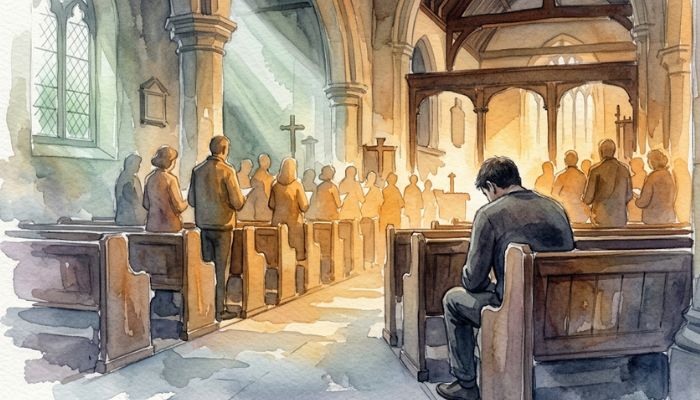
The song says the joy of the Lord is your strength, and the room around you is singing it with both hands raised, and you are standing in the third row feeling nothing at all. Not rebellion. Not doubt, exactly. Just a flat grey absence where the feeling is supposed to be. You mouth the words. You hope no one looks too closely. You wonder, again, what is wrong with you that everyone else seems to have something you have lost.
That gap, between what is being sung and what you are able to feel, is where a great many faithful people quietly live. The church has not always known what to do with them. This is the first in a series on "What the Church Needs to Know about Mental Health".
The first thing to understand is the difference between sadness and depression, because the church frequently collapses the two.
Sadness is a response to circumstances. Something happens, and you feel the weight of it, and as the circumstances shift, the feeling shifts with them. Sadness has a cause you can name and, usually, an end you can foresee.
Clinical depression is not that. It is a condition that persists regardless of circumstances. It does not lift because something good happened. It does not respond to a holiday, a promotion, an answered prayer, a beautiful morning. It sits underneath all of those, unmoved, because it is not a reaction to your life. It is a condition operating in your body and mind largely independent of your life.
Depression is a whole-person condition. It lives in the body, in the disrupted sleep and the leaden fatigue and the appetite that has gone strange. It lives in the mind, in the slowed thoughts and the difficulty concentrating. It lives in the emotions, in the flatness. And it lives in the will, in the inability to make yourself want things. It is not one symptom. It is a fog that settles over the entire person at once. See the following infographic.
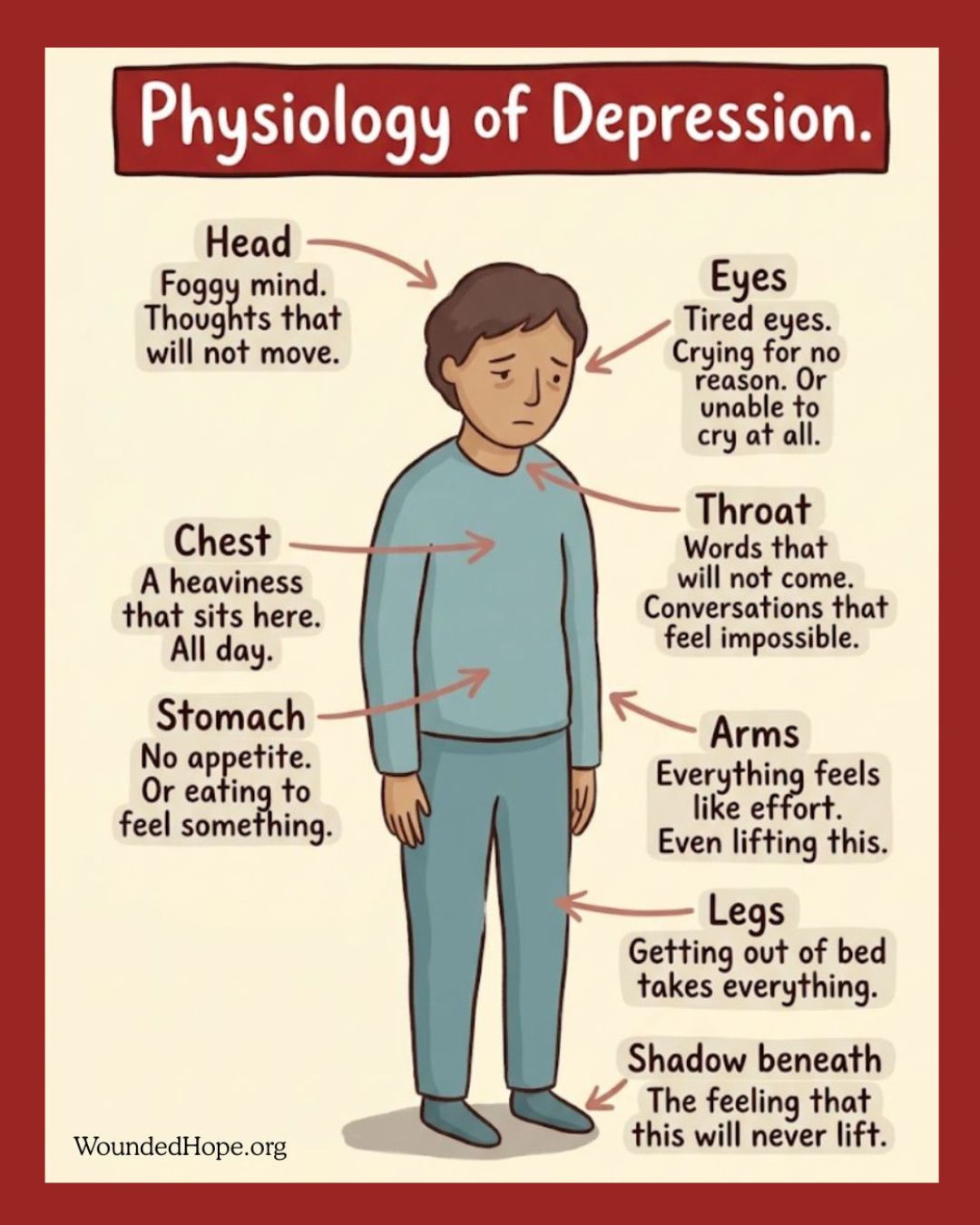
So there are at least three things depression does that the people around the sufferer usually cannot see.
The first is cognitive fog. Thinking becomes effortful. Decisions that used to be automatic become exhausting. The mind moves as though through water.
The second is emotional flatness. Not sadness, which at least is a feeling. Flatness. The colour drains out. Things that should move you do not move you. You watch your own life from behind glass.
The third is the one the church finds hardest to grasp. Depression removes the ability to want things, and that includes the ability to want God. The desire that used to carry your prayer is gone. Not because you have rejected him. Because the machinery that produces desire has, for now, stopped working. This is not backsliding. It is a symptom.
None of this is rare. It is sitting in your congregation this Sunday, in the third row, mouthing the words.
Many evangelical and charismatic churches treat depression, in practice if not in stated doctrine, as a faith problem. The unspoken message reaches the sufferer clearly enough. If you were praying enough, believing enough, confessing enough, walking closely enough, this would lift.
It is worth being honest about where this comes from, because it does not come from nowhere. It comes from a flattened reading of Scripture. The verses about joy, about peace that passes understanding, about the abundant life, get stripped of their context and turned into performance metrics. Joy becomes a thing you are failing to produce. Peace becomes evidence you are failing to claim. The abundant life becomes a standard your flat grey interior is visibly not meeting.
What this does to a depressed person in the pew is cruel, even when no cruelty is intended. They are already carrying the full weight of the condition. The church then adds a second weight on top of it, the weight of spiritual failure. Now they are not only depressed. They are depressed and, they have been led to believe, spiritually deficient for being so. Many of them stop coming. Many of them stop disclosing. Many of them sit in the third row and perform a wellness they do not have, because the alternative is to be told to pray harder.
This is not an argument against prayer, Scripture, or spiritual practice. Those things matter deeply, and they are not in competition with anything in this article. But they are not a treatment protocol for a medical condition, any more than they are a treatment protocol for a broken bone. You would pray for someone with a fractured leg. You would also drive them to have it set. The prayer and the cast are not rivals. The church has understood this about bones for a long time. It has been slower to understand it about brains.
The Bible is not silent about this kind of collapse. It gives us, among others, Elijah.
In 1 Kings 19, Elijah has just come off the greatest victory of his prophetic life. Fire from heaven on Mount Carmel. The prophets of Baal defeated. The vindication of God before all Israel. And immediately after this triumph, he collapses. He runs into the wilderness, sits down under a broom tree, and asks the Lord to take his life. It is enough; now, O Lord, take away my life, for I am no better than my fathers (1 Kings 19:4). Then he lies down and sleeps.
Watch what God does not do.
He does not rebuke Elijah. He does not challenge his faith. He does not remind him of the fire on the mountain and ask how he could possibly despair after such a victory. He does not tell him to pray more, or confess a hidden sin, or claim his joy. He does not demand that Elijah get up and pull himself together.
What God does is quieter, and it is the model.
He lets Elijah sleep. Then an angel touches him and gives him food and water. Arise and eat (1 Kings 19:5). Elijah eats and sleeps again. The angel comes a second time, with more food, and says a sentence the church should have framed on its walls. Arise and eat, for the journey is too great for you (1 Kings 19:7).
The journey is too great for you. Not, the journey reveals your weak faith. Not, you should be stronger than this. The journey is too great, and so, before anything else, here is food, here is water, here is sleep. The spiritual conversation, the still small voice, comes later, after the body has been cared for. God's first response to his collapsed prophet is physical before it is spiritual, presence before it is proclamation.
This is the pattern the church is being given. When someone collapses, the first ministry is not correction. It is care.
And for those who cannot yet see any light at the end, there is Psalm 88, the one psalm in the whole Psalter that never turns. It has no but, no yet, no closing pivot toward hope. It begins in the dark and ends, in the Hebrew, on the word darkness. Its presence in the canon is God's own permission to sit in the dark without being forced to a conclusion. If the Holy Spirit preserved a prayer with no resolution, the church can learn to sit with people whose suffering has not yet resolved either.
This is not abstract. There are things that can change this week, and they look different depending on who is reading.
If you are living with depression. You are not failing God. The fog, the flatness, the absence of feeling, none of it has removed you from grace, and none of it is evidence of weak faith. The desire for God that you cannot currently feel is a casualty of the condition, not a verdict on your soul. You are allowed to get help. Medication, therapy, and professional support are not a betrayal of faith. They are faithful stewardship of the body and mind God gave you, the same kind of stewardship as setting a broken bone or treating an infection. Getting help is not the opposite of trusting God. It can be one of the ways you do.
If you are supporting someone with depression. Stop asking them to feel better, and start showing up without an agenda. The most faithful thing you can do is what God did for Elijah. Be present. Provide practical care. Resist the urge to fix or explain. Send the message that needs no reply. Bring the meal. Sit in the silence and let it be silent. Do not require them to perform recovery for your comfort, and do not treat their slowness as ingratitude. Your steady, undemanding presence will preach more than any verse you are tempted to offer.
If you are a pastor or church leader. Your congregation has people living with depression right now, and some of them have never told you, because they are afraid of what you will say. Three things would change that. Preach on lament with real theological seriousness at least once a year, so the people in the dark know there is room for them in your pulpit and not only in your prayer requests. Build a referral pathway to professional mental health support, so that when someone discloses, you have somewhere to point them beyond your office. And train your pastoral care team to respond to disclosure with presence rather than prescription, so that the person who finally works up the courage to say I think I am depressed is met with a chair and a cup of tea rather than a diagnosis of their faith.
***
The person in the third row is still there next Sunday. The song still rises, and the gap is still there between what is sung and what can be felt. But imagine that this time, the person beside them knows. Imagine a church where the flatness does not have to be hidden, where the disclosure is met with care instead of correction, where someone says the journey is too great for you and then simply sits down beside them.
That person would not be fixed. Depression does not work that way, and honesty will not pretend otherwise. But they would be seen. And to be seen, in the dark, by people who do not flinch and do not rush you toward a light you cannot yet feel, is its own kind of mercy. It is not a cure. It is the beginning of not being alone in it.
Part 1 – Depression
Part 2 – Anxiety
Part 3 – Bipolar Disorder
Part 4 – Schizophrenia
Part 5 – OCD
Part 6 – PTSD
Part 7 – Psychosis