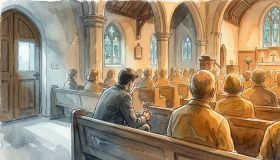
She sits in the third row every Sunday. She arrives early, leaves quickly, never stays for coffee. From the outside she looks composed, perhaps a little reserved. Inside, she has already rehearsed every possible conversation, anticipated every social demand, and worked out the fastest route to the exit. She has been doing this since she woke at 3am, when the thoughts started again and would not stop. She loves God. She is terrified of nearly everything else. And she has never told anyone at church, because she is not sure they would understand.
This is the second in a series on "What the Church Needs to Know about Mental Health".
Anxiety is one of the most misunderstood conditions in the church, and the misunderstanding starts with a word everyone thinks they already know.
Everyone worries. A hard season, an uncertain future, a difficult decision, these produce worry, and worry is a normal part of being human. Worry responds to circumstances. It rises when there is something to worry about, and when the circumstances change, it eases. It has a cause and, usually, an end.
Clinical anxiety does not work this way.
Anxiety is a condition in which the body's alarm system is set permanently too high. It fires without a proportionate trigger. It fires when nothing is wrong. It fires at 3am when the house is quiet and the family is safe and there is no rational reason on earth for the chest to tighten and the heart to race, and yet they do. The person living with anxiety is not overreacting to their life. Their nervous system is sounding an alarm for a threat that their mind knows is not there and their body cannot stop detecting.
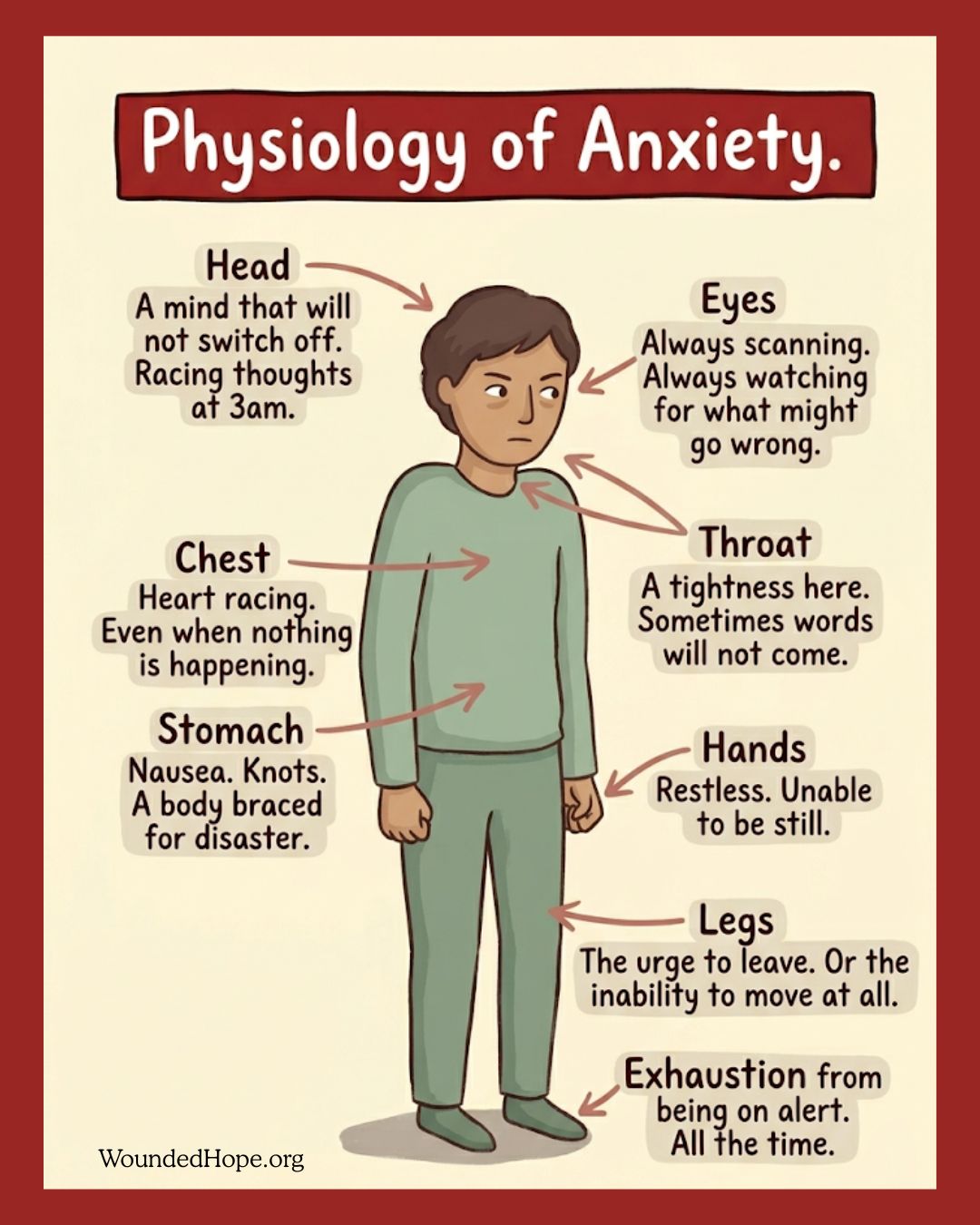
It lives in the body as much as the mind. The tight chest. The racing heart. The nausea. The hypervigilance that scans every room for exits and every conversation for danger. The restlessness that will not settle. The bone-deep exhaustion that comes from running an alarm system at full volume every waking hour. Here's an accompanying infographic that maps what anxiety does physically.
This is not a character flaw. It is not a failure of trust. It is a medical condition affecting how the nervous system processes threat, and it is present in your congregation right now, probably better disguised than almost any other struggle in the room.
Of all the things well-meaning Christians say to someone living with anxiety, this is the most common, and it does the most harm.
It is usually drawn from Philippians 4:6. Do not be anxious about anything, but in every situation, by prayer and petition, with thanksgiving, present your requests to God. The intention behind quoting it is kind. The application is wounding.
Offered as a prescription to someone with clinical anxiety, the verse implies that their condition is the result of insufficient prayer or inadequate surrender. That if they were really trusting God, the alarm would switch off. That the fact that it has not switched off is evidence of a faith problem rather than a medical one. The sufferer hears, underneath the kind tone, a verdict. You are anxious because you have not given it to God properly.
That is not what Paul is saying, and the context makes it plain.
Paul wrote Philippians from prison. He was not writing from a settled life with resolved circumstances and calm emotions. He was writing from confinement, facing a genuinely uncertain future, possibly facing execution. The peace he describes in the next verse, the peace that passes understanding, is not the absence of distress. It is a peace that guards the heart in the middle of distress, a theological orientation that holds in the presence of fear rather than removing it. Paul is not describing a technique that eliminates anxiety. He is describing a practice of prayer that coexists with real suffering.
The person with clinical anxiety is not failing to give it to God. They are carrying a condition that prayer supports but does not cure, in the same way prayer supports but does not cure asthma or high blood pressure. Telling them otherwise does not grow their faith. It grows their shame, and it sends them out the door before coffee.
The Bible does not hand us a Saviour who was a stranger to dread.
In Gethsemane, Jesus knelt and asked the Father to take the cup away. Being in anguish, he prayed more earnestly, and his sweat was like drops of blood falling to the ground (Luke 22:44). The text describes a physical response to overwhelming distress so extreme that the sweat fell like blood. Whatever the precise physiology, the picture is unmistakable. The Son of God, fully human, experienced in his own body the acute physical weight of dread.
Watch what he did with it.
He did not perform peace. He did not suppress what he was feeling or scold himself for feeling it. He did not decide that a faithful Son would not be in anguish and therefore hide the anguish. He brought it to the Father, openly, in his body, and he held it alongside his surrender. Not my will, but yours be done (Luke 22:42). And what he received was not the removal of the cup. It was the presence of an angel who strengthened him for what was coming (Luke 22:43). Not resolution. Presence, and strength to walk into the thing he had asked to be spared.
This is the biblical model for anxiety. Not the elimination of dread, but the honest naming of it in the presence of God. Not the performance of trust, but the practice of trust in the middle of fear.
The psalms of lament carry the same permission. My heart is in anguish within me; the terrors of death have fallen on me (Psalm 55:4). The same writer says, Oh, that I had the wings of a dove! I would fly away and be at rest (Psalm 55:6). That is not weak faith. That is the honest prayer of a person whose nervous system is overwhelmed, bringing the overwhelm to God without dressing it up first.
The person with anxiety does not need to perform peace for God before they are allowed to approach him. They can bring the tight chest, the racing heart, and the 3am thoughts directly to the one who already knows them and who knelt, sweating, in a garden himself.
If you are living with anxiety. You are not failing to trust God. The racing heart, the tight chest, the thoughts that will not stop at 3am, these are not signs of insufficient faith. They are signs that your nervous system needs support. Getting that support, through therapy, medication, or both, is not a failure of faith. It is faithful stewardship of the body and mind God gave you, the same stewardship as treating any other condition of the body. You are allowed to ask for help. You are allowed to need more than prayer, and needing more than prayer is not an insult to prayer.
If you are supporting someone with anxiety. Resist the urge to offer solutions. Anxiety does not respond to logic, reassurance, or spiritual prescriptions, and trying to talk someone out of it usually leaves them feeling more alone. What helps is presence without pressure. They do not need you to argue them out of what they are feeling. They need you to stay in the room without requiring them to feel differently. Practical care matters too. Go with them to the appointment. Sit with them before the thing they are dreading. Check in without needing a reply. Small, consistent, undemanding presence heals more than any single conversation.
If you are a pastor or church leader. Examine how anxiety shows up in your preaching. If every reference to it ends with just trust God or give it to prayer, you are teaching your congregation, without meaning to, that clinical anxiety is a faith failure. Preach Gethsemane with full honesty. Name anxiety as a medical condition from the platform, out loud, at least once, so that the people hiding it know you know. Make room in your pastoral care for disclosure without spiritual judgment, and build a referral pathway to professional support that people actually know exists. The woman in the third row who leaves before coffee needs to know that your church is a place where she could tell the truth and still belong.
***
She is still in the third row. She has been there two years. She has heard the sermons on peace, on trust, on the faithfulness of God, and she believes all of it. She still wakes at 3am with a chest that will not unknot and thoughts that will not stop.
What she has not yet heard is that her condition has a name, that it is not her fault, and that the church she has been quietly slipping out of every Sunday might be a place where she could finally say so. That is what faithful response looks like. Not the removal of her anxiety. The slow building of a community where it can be named without shame, carried without judgment, and met with the same presence that met Jesus in the garden, when the sweat fell like blood and the cup had not yet passed.
Part 1 – Depression
Part 2 – Anxiety
Part 3 – Bipolar Disorder
Part 4 – Schizophrenia
Part 5 – OCD
Part 6 – PTSD
Part 7 – Psychosis