He came back from the war and sat in the third pew every Sunday. Nobody knew what he was carrying. From the outside he looked fine. Composed, reliable, always early, always in the same seat. Inside, the service was a minefield. The opening drum fill sent his heart rate through the roof. The press of the crowd during the greeting time made him want to bolt. One song the worship team played most weeks had four bars in it that sounded enough like something he had heard in another country to set his hands shaking under the order of service. He stayed. He sang. He shook hands. He drove home and sat in his car for forty minutes before he could go inside. He had never told anyone. He did not have the words, and he was not sure the church had the categories.
This is the sixth in a series on "What the Church Needs to Know about Mental Health".
Post Traumatic Stress Disorder develops in some people after exposure to a traumatic event or series of events. It is not a character flaw. It is not a failure to move on. It is not evidence of weak faith or insufficient resilience. It is what happens when the brain's threat-processing system is overwhelmed by something it cannot fully integrate, and stays locked in a state of high alert long after the danger has passed.
PTSD tends to show up in four ways. There is intrusion, where the trauma returns uninvited through flashbacks, nightmares, and memories as vivid and immediate as the original event. There is avoidance, where the person quietly organises their whole life around not encountering anything that might trigger a return to the traumatic material, steering away from particular people, places, sounds, and situations. There are negative changes in thinking and mood: persistent dark beliefs about oneself or the world, emotional numbness, a sense of estrangement from others, an inability to feel the good things. And there is hyperarousal, a nervous system permanently set to high, producing an exaggerated startle response, trouble concentrating, disrupted sleep, and irritability.
PTSD is not limited to combat veterans. It develops following sexual assault, childhood abuse, domestic violence, sudden bereavement, serious accidents, medical trauma, and long exposure to threatening environments. It is sitting in your congregation in more seats than you know. See accompanying infographic.
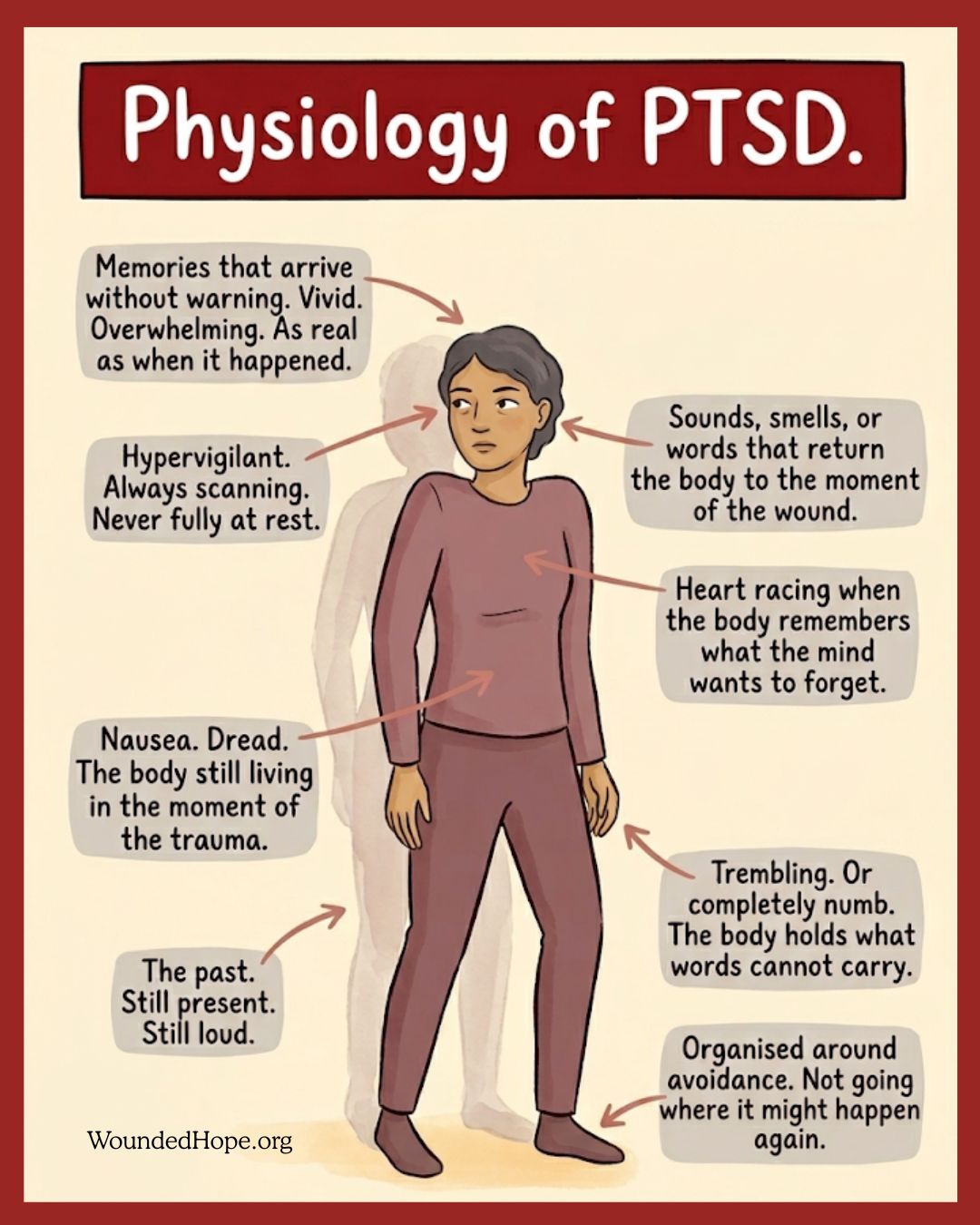
The body keeps the score, and that is not a metaphor. The traumatic experience is stored in the body, in the nervous system, in the muscles, in the involuntary responses of a body that learned to survive something and has not yet received the message that the survival is complete.
The church has a particular vulnerability around trauma, because the gospel is a story of redemption, and redemption is easily misread as a demand to arrive quickly at resolution. Forgiveness is real and important. Healing is possible. The resurrection is true. But these realities are frequently turned into weapons against people living with PTSD, and the damage is significant.
The most common version is the pressure to forgive as the price of healing. A person processing abuse or assault or domestic violence is told, sometimes outright and sometimes only by implication, that their ongoing suffering is evidence of unforgiveness, and that if they would simply release the person who harmed them, they would be released from the symptoms. This is psychologically inaccurate and theologically imprecise. Forgiveness is a relational and moral category. PTSD is a neurological one. Forgiving an offender does not rewire a nervous system. A person can extend genuine, costly forgiveness and still have flashbacks, still startle, still avoid, because those symptoms were never caused by unforgiveness in the first place. They are caused by trauma held in the body.
Forgiving someone does not switch off a flashback. The symptoms are not stored in the will. They are stored in the body.
The second harm is the pressure to testify too soon. Church culture loves the person who has come through suffering and can speak about it from a platform with resolution and hope. There is nothing wrong with that in itself. But placed on someone still in the acute phase of PTSD, it forces them to perform a healing they have not experienced, to fold their trauma into a tidy shape the church finds comfortable, and to go public before they are ready. That does not speed healing. It disrupts it.
The church does not have to choose between holding out hope for healing and holding space for the person who is not there yet. What it cannot do is hold space and demand resolution at the same time.
The psalms of lament hold PTSD more honestly than almost anything else in Scripture. My heart is in anguish within me; the terrors of death have fallen on me. Fear and trembling beset me; horror has overwhelmed me (Psalm 55:4-5). That is not poetic flourish. It is a description of a nervous system under siege, the racing heart, the trembling, the dread that arrives without a present cause. The psalmist does not resolve it by an act of will or a declaration of faith. He names it, brings it to God, and longs for the wings of a dove so he can fly away and be at rest (Psalm 55:6).
Lamentations gives us a whole community processing collective trauma with brutal honesty and no quick resolution. The book does not end in restoration. It ends in an open question. Restore us to yourself, Lord, that we may return; renew our days as of old, unless you have utterly rejected us and are angry with us beyond measure (Lamentations 5:21-22). The trauma is named. The grief is held. The question is left hanging.
And Job gives us a man whose suffering is not the result of sin, whose friends keep insisting on a tidy theological explanation for what has none, and whose rawest, least resolved prayers are the ones God ultimately vindicates. The friends' speeches sound a great deal like what the church often says to trauma survivors, and God says plainly that they did not speak of him what was right (Job 42:7).
Scripture does not require trauma survivors to reach resolution before they are allowed to speak honestly. It hands them language for the experience itself, in all its disorientation and grief, and it holds the door of restoration open without forcing them through it on a schedule.
If you are living with PTSD. What happened to you was real. What your body is doing in response is not weakness or failure. It is survival. The flashbacks, the hyperarousal, the avoidance, the numbness, these are the marks of a nervous system that kept you alive and has not yet learned that it is allowed to rest. You deserve professional support from a trauma-informed therapist; treatments like EMDR, trauma-focused CBT, and somatic therapies have strong evidence behind them. You also deserve a church that does not ask you to perform healing before you have experienced it, that does not confuse forgiveness with the absence of symptoms, and that can sit with you in the long middle without rushing you to the end. That community is possible, and you are allowed to need it.
If you are supporting someone with PTSD. Learn what triggers actually are. A trigger is not an overreaction or a manipulation. It is an involuntary neurological response to something associated with the original trauma. When someone is triggered, the reasoning part of the brain is partly offline and the survival part is running the show, which is why arguing, reasoning, or reassuring in that moment rarely helps. What helps is calm, consistent, undemanding presence. Ground them gently if they are dissociating. Do not press for details of what happened. Do not require them to justify their avoidance. Be the person who shows up the same way every time, without drama and without agenda. That steadiness is one of the most healing things one human being can offer another.
If you are a pastor or church leader. Make your worship environment as safe as you reasonably can for people carrying trauma. This does not mean stripping out everything that might affect anyone. It means being thoughtful. Loud sudden sounds, extended physical contact during the greeting, darkened rooms, and certain lyrics can all function as triggers. Consider offering a quiet-room option during services. Train your welcome team to notice distress and respond without drawing attention to it. Preach on lament often enough that the person in the third pew knows the church has a category for unresolved suffering. And build a referral pathway to trauma-informed professional care, because pastoral support and professional therapy are not rivals. They work best together.
***
He is still in the third pew. The hands still shake during the four bars that sound like something else. The greeting time is still hard. He has learned to manage what he can, to leave before the final song when the crowd presses in, to sit near the aisle so there is always a clear way out.
What he has not yet found is a church that knows enough about what he is carrying to make the room a little safer, or a pastor who understands that the shaking hands are not a lack of faith but a body remembering something it has not finished grieving. That church is possible. It takes knowledge the church does not always have and patience the church does not always offer. It takes the willingness to hold someone in the long middle without demanding they reach the resolution the gospel promises before they are ready. The body keeps the score. The church can learn to hold the scorecard with grace.
Part 1 – Depression
Part 2 – Anxiety
Part 3 – Bipolar Disorder
Part 4 – Schizophrenia
Part 5 – OCD
Part 6 – PTSD
Part 7 – Psychosis