You were small the first time it happened. Too young to defend yourself, old enough to remember. Someone stood you next to another child and said it out loud. Why can't you be more like her. Look how well he sits still. Your cousin already reads, and you don't. You had no words yet for what that did to you. Your body learned it anyway. Somewhere inside, a small verdict went down: there is a right kind of child, and you are not it.
Children believe the big people. That is how they survive. When the ones who feed you and tuck you in at night also tell you, in a hundred small ways, that you fall short, you do not argue. You cannot. You take the picture they hand you and carry it as if it were your own face.
So you grew up measured. Your cousin was slimmer, they said, prettier, the one people noticed when you walked in together. The sibling who never gave anyone trouble. Some smoother, more beautiful version of a person you were meant to have become by now. Every room had a scale in it, and you always seemed to weigh wrong. You were the ugly duckling of the family, and everyone had a way of letting you know it.
You remember the exact words. A relative said it lightly, over a meal, the way you'd comment on the weather. Look how lovely your cousin is. Not cruel, in their mind. Just true. You sat there small and silent, and you did the only thing a child can do with a sentence like that. You believed it. You folded it into the picture you were building of your own face.
A picture built from other people's faces is not a portrait. It is a rumour. And you have believed the rumour most of your life.
You were the ugly duckling of the family, and everyone had a way of letting you know it.
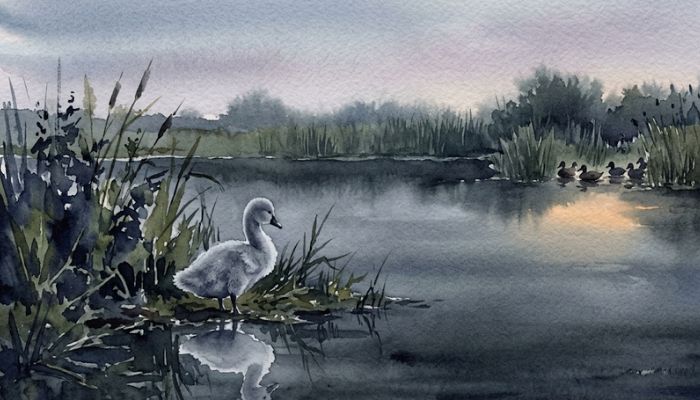
Andersen's duckling never looked wrong to himself until the yard told him so. He hatched, he swam, he did what the water asked. Then the ducks and the hens agreed he was too big and too grey and too strange, and he believed them, because who else was there to believe. His own mother turned. The brothers who shared his nest pecked him and wished him gone. He fled into a whole miserable winter, running from a verdict about his own body. And the cruelest part was that it was never true. He was not an ugly duck. He was a swan among creatures with no category for him.
You know what it is to be that duckling. The one who did not fit the family you were born into. The one whose difference got read as defect. Maybe the comparisons were spoken aloud. Maybe they were only ever a look, a sigh, a favour shown to someone else while you stood there learning to be less. Either way it went in deep, because it came from the people who were supposed to see you first.
That is why a stranger's cruelty glances off, but the household voice stays. The mother who compared you. The father who withheld. The sibling always held up as the standard. Those voices moved in, and they became the way you talk to yourself now, decades on, when you catch your reflection and flinch.
Against all that noise, Scripture says something almost unbearable. "For you created my inmost being; you knit me together in my mother's womb. I praise you because I am fearfully and wonderfully made; your works are wonderful, I know that full well. My frame was not hidden from you when I was made in the secret place, when I was woven together in the depths of the earth. Your eyes saw my unformed body; all the days ordained for me were written in your book before one of them came to be" (Psalm 139:13-16).
Look at the order of it. Before the comparisons, the knitting. Before anyone held you up against a better child, before a single measurement was spoken over you, you were already being made on purpose, watched over in the dark, written down. The verdicts came later. They came loud. But they came second.
The duckling was already, from the first crack of the shell, the thing he would grow into. Nothing was added in the spring. The swan was not a reward for surviving the winter. It was what he had been all along, unseen.
You were that too. Whatever they compared away, whatever they missed when they stood you next to someone easier, the truest thing about you was woven in before they ever looked. God was not squinting at you in confusion. He was not disappointed that you were not the other child. He made this one. On purpose. In the secret place, with His own hands, and He called the work wonderful.
That does not erase the ache. You still carry the years. The old mirror does not shatter the moment you learn it was lying. It cracks slowly, one true word at a time, and some mornings it still shows you the ugly duckling you were told you were.
But the water knew what the yard did not. When the duckling finally bent to drink and saw himself at last, he did not turn into a swan in that instant. He saw, for the first time, what had always been swimming there.
You have trusted the wrong faces long enough. The One who knit you was there first, before all of them, and He has never once mistaken you for someone else.
You are still here, still swimming, and the reflection was never the truest thing about you.
The water always knew. There is a song for that, if you want to sit with it a while longer. Listen here: