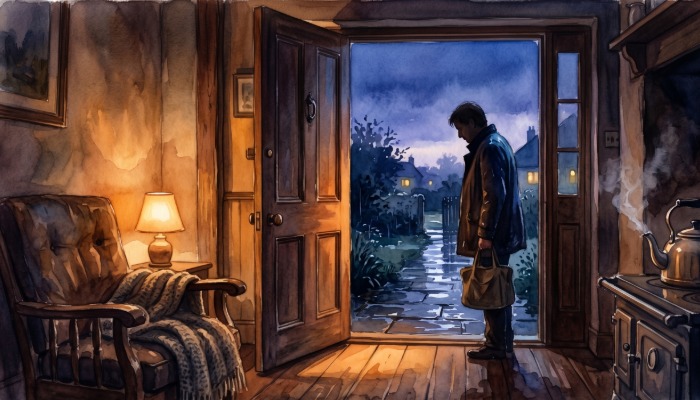
The meal train ends.
Someone in the church has a baby, or a surgery, or a bereavement, and the sign-up sheet appears. For six weeks the casseroles arrive. Then the sheet expires, the meal train ends, and the family is expected to be back on their feet.
For most acute crises this works. Six weeks is roughly long enough for the immediate dust to settle. The family starts cooking again and the community moves on to the next crisis.
Mental illness does not run on a six-week calendar. The depression does not lift in six weeks. The anxiety does not resolve in six weeks. The grief that has tipped into something deeper does not pack up and leave. Schizophrenia, bipolar, long PTSD, these may be a person's companion for the rest of their life, and a meal train designed for a different kind of crisis runs out long before the suffering does.
When it ends and the suffering continues, something quietly painful happens. The person in the long illness watches the community step back on schedule and concludes, usually in silence, that they have used up their allotted compassion. Without anyone teaching them, they learn to stop telling people how they are.
Isaiah asks for more than a meal train. The fast the Lord chooses is "to provide the poor wanderer with shelter" (Isaiah 58:7). Not food sent to a door. Shelter, which is a roof rather than a delivery, and a roof is not a six-week arrangement.
A visit is bounded. It has a start time and an end time, and it can be put in a calendar, executed and ticked off. Visits are good, and they are what the meal train provides.
A stay is unbounded. It costs the host more than they planned to spend, and the cost is rarely obvious in advance.
The church is very good at visits and very bad at stays. We mobilise for a crisis. We fill out sign-up sheets. We show up for the funeral, the hospital, the first month after the diagnosis. What we struggle with is the eighth month. The fourteenth month. The third year.
The long illness lives in the eighth month. It lives in the second year. It lives in the quiet weather after everyone else has moved on, which is exactly where the person most needs company.
Bringing someone under your roof is the slow practice of staying past the point of social obligation.
This rarely means literal house-sharing. Isaiah is doing pastoral work rather than real-estate work, and the shelter he describes is a metaphor for moving someone from the periphery of your life to the interior of it. From your acquaintance list to your weekly rhythm. From the people you pray for on Sunday to the people whose numbers are in your phone, who you text on a Wednesday afternoon for no particular reason.
The text on a Tuesday with no agenda. Thinking of you, no need to reply. The standing coffee on the second Saturday of every month, kept even when nothing seems to be happening. The walk that became a small habit. The presence at a routine hospital appointment. The Christmas card in year three, when most people stopped sending them in year one. The willingness to ask, in November, how the dark months are treating them, and to mean it.
These feel inadequate to the size of what the person is carrying. Over the long years of a chronic illness they are the most healing thing the church has to offer, because the community that stays communicates the one sentence that finally matters. You are not forgotten.
The stay costs hours you would have used otherwise. It costs the emotional energy of carrying another person's weight when your own is heavy enough. It costs the discomfort of sitting with a suffering that does not resolve after all your love. Sometimes it costs the friendship you had before, because the person you are accompanying is not who they were when the illness began, and the friendship has to adjust to who they are now.
Scripture does not flinch from that cost. "Carry each other's burdens, and in this way you will fulfill the law of Christ" (Galatians 6:2). The Greek word is baros, a heavy weight, a load that crushes. Paul is describing the literal carrying of something that would crush the one carrying it, not light social courtesy, and he says the law of Christ is fulfilled in exactly that.
This is the slow expenditure of one life on behalf of another. It is what Christ did for us, and what we are called to do for each other in smaller and partial ways. A church where nobody carries any real weight is not, in any biblical sense, a church.
You are allowed to rest.
If you are in the third year of accompanying someone through a long illness, tired in a way you do not always let yourself name, the carrying does not have to be a solo act. Having been the one who stayed does not oblige you to be the only one who stays. When you are exhausted, the answer is not to carry harder. Find one or two others to share the load. The stay was always meant to be a community practice.
And the One doing the deepest carrying, of you and of the person you are accompanying, is in the long quiet weather too. "Cast your cares on the LORD and he will sustain you" (Psalm 55:22). The psalm does not tell you to hold it alone. It tells you where to put it down. The strength you have had to keep showing up has not been only your own.
You are not a burden. You are a person in a long season of difficulty, and the church the Lord is building is supposed to be a place where people in long seasons of difficulty are not left alone.
If you have not had that community, it is not because you did not deserve it. It is because the church has, in many places, forgotten how to do this, and the forgetting is not your fault.
One or two people in your life are probably capable of the stay. They are quieter than you expect and they do not advertise. The friend who texts for no reason. The neighbour who keeps turning up at your door with no agenda. The old church member who has not let you drift out of her life. Those are the carriers, and they are the church the Lord is slowly building.
Part 1: Sharing Bread without asking why
Part 2: Bringing them into your House
Part 3: The Sanctuary Outside the Building
Part 4: Suffering is not Punishment