Most of us remember the day we faced reality. Life had changed, and the old way of doing things no longer worked. For a while we carried on as before, sometimes for years. Then one ordinary morning we admitted it, if only to ourselves.
Elisha's students lived and studied near him. One day they said it to his face: "Look, the place where we meet with you is too small for us. Let us go to the Jordan, where each of us can get a pole; and let us build a place there for us to meet" (2 Kings 6:1-2).
They could have squeezed in a few more benches and carried on. Instead they admitted the room no longer fitted.
They did not curse the old room. They had met with Elisha there for years, and good things had happened inside those walls. Even as they planned to leave, they spoke of building "a place there for us to meet." They still wanted the prophet with them.
Elisha's reply was a single word: "Go" (2 Kings 6:2). So they picked up their tools and set off for the river. "And he went with them" (2 Kings 6:4).
The work at the Jordan would have been loud. Axes rang against trunks, and men called out to one another as the trees came down. Somewhere in all that noise, one man swung, and his handle came back light.
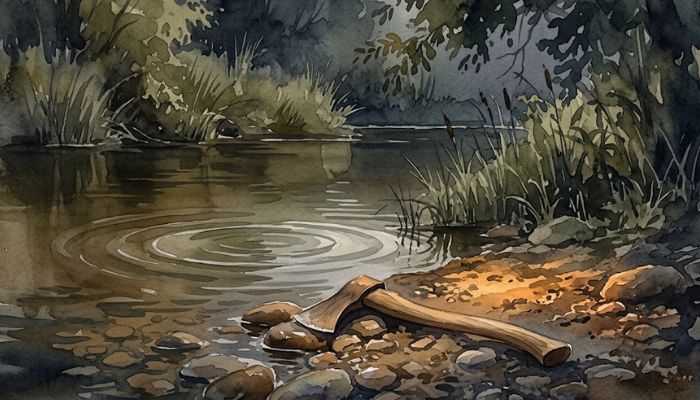
The iron head had flown off and dropped into the river. "'Oh no, my lord!' he cried out. 'It was borrowed!'" (2 Kings 6:5)
Iron was expensive, and these men were poor. He had no money to replace it and no way to get it back. Whatever the owner said next, he would have to face it.
He cried out before he had a plan or an excuse.
Many of us would rather wait. We want to fix the problem first, or at least have an explanation ready, before anyone sees what we have lost. So we keep quiet and rehearse the story in our heads until it sounds respectable.
His words were barely a sentence, a cry of alarm and a plain fact. Yet he said them to the one person who could help, and he said them at once.
Elisha could have prayed over the whole river. Instead, he wanted the man to show him the spot. "The man of God asked, 'Where did it fall?'" (2 Kings 6:6)
The others may have lowered their axes to watch as the man walked back to the edge of the water. The Jordan runs brown with mud, and he could see nothing below the surface. To everyone else, that stretch of river looked like all the rest. He alone knew where the iron had gone in.
So he lifted his arm and pointed.
He was pointing at his loss in front of his teacher and his friends, with no idea what Elisha would do.
"When he showed him the place, Elisha cut a stick and threw it there, and made the iron float. 'Lift it out,' he said. Then the man reached out his hand and took it." (2 Kings 6:6-7)
Your place of loss may look like ordinary water to everyone else. Life carries on around it. Yet you know the exact spot. Maybe it is a conversation you keep replaying, or a season you cannot get back.
Perhaps you have already faced it on some ordinary morning. Perhaps you have already cried out to God in a few words that hardly sounded like prayer. Those words were enough to begin.
God now asks you the question Elisha asked the man at the river. You do not need to explain why it happened or decide who was to blame. You only need to show him where it fell.
You do not need to explain why it happened. You only need to show God where it fell.
Not every lost thing rises the way that axe-head did. Some things stay under the water for a long time. You may not know yet what will happen to yours, and you do not have to know today. You can keep hoping without forcing an answer.
Whatever happens to the iron, God still asks where it fell, and he is still there to see.