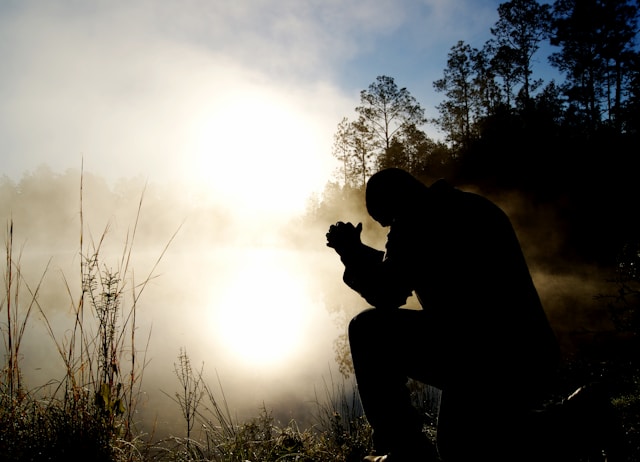
Jesus prayed on the night before he died. He went into a garden, late, with friends who were tired and who would be asleep on the ground within the hour, a stone's throw away (Luke 22:41). He went a little further by himself and fell on his face.
"My Father, if it is possible, may this cup be taken from me. Yet not as I will, but as you will" (Matthew 26:39). He asked, then he asked again, then a third time. Luke says that "his sweat was like drops of blood falling to the ground" (Luke 22:44).
The cup was not taken.
Most of us were raised on a Christianity that has not quite known what to do with this scene. We have heard good sermons on the obedience at the end, on "not as I will, but as you will," and fewer on the part that comes before it. The part where the Son of God asked his Father for something and did not get it.
It matters that this is not a half-hearted disciple with weak faith, or someone who had skipped the inner work. This is the Son, in the hour of his deepest faithfulness, asking the Father for a thing the Father had power to give.
It matters, too, how he asked. Not once, politely, before accepting the silence. Three times. He sweated. He told his friends, "My soul is overwhelmed with sorrow to the point of death" (Matthew 26:38). The asking was anguished and embodied and repeated, which is to say he prayed the way you have been praying through the long nights when nothing has been moving.
Nobody reads Gethsemane as a failed prayer. It has always been read as the most faithful prayer Jesus ever prayed, though he did not get what he asked for, because in the asking and the not-receiving and the staying with the Father through both, he showed us what prayer is for.
Prayer is not a way of getting what we want.
That is hard to hear, because somewhere in your life you were told the opposite. Pray with enough faith and the answer will come. If the answer is not coming, the problem is in your input. Not enough faith, wrong words, some hidden corner of disobedience. The unanswered prayer becomes a verdict on the one praying.
In the garden, the most faithful person who ever lived prayed the most honest prayer he knew, three times, and the cup was not taken.
If unanswered prayer is a verdict on the one praying, then the verdict on Jesus is one none of us should be willing to render.
The asking was real, and so was the hoping. But the deepest thing prayer was doing in that olive grove was keeping the Son in the company of the Father on the night he most needed it. The conversation did not get him out of the cross. It got him through the next several hours. He stood up from the ground, he did not run, and he walked into the thing he had asked to be spared without walking into it alone.
If you have been praying for something a long time and the answer has not come, you are not outside the Christian story. You are standing where the Lord himself stood, asking what he asked, in the company he kept on the worst night of his life.
Your prayers are Gethsemane prayers. Honest, repeated, costly, doing what prayer does in the dark, keeping you in company with a Father who is closer than the silence makes him feel.
The cup may not be taken. I cannot promise you it will be. The honest pastoral thing is to say what the garden says: sometimes the answer is no, the no is not a verdict, and the one who did not take the cup away stayed in the garden until the soldiers came.