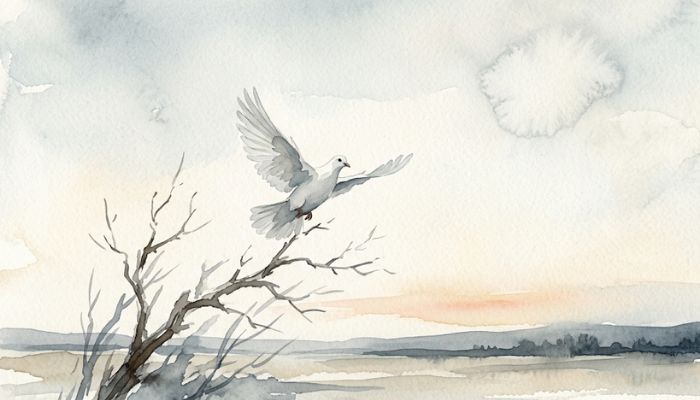
Everyone has a version of the wish. You are sitting in the middle of something you cannot fix, the phone heavy with messages you cannot answer, the walls of the room too close, and a single thought rises clean and bright above all the noise: I want to be somewhere else. Not dead. Not even far, necessarily. Just out. Gone from this, where none of it can reach me.
David had that wish too, and he put it into words so honest they should probably embarrass us out of pretending we are stronger than we are.
"Oh, that I had the wings of a dove! I would fly away and be at rest. I would flee far away and stay in the desert; I would hurry to my place of shelter, far from the tempest and storm" (Psalm 55:6-8).
Read it slowly. This is a king, a warrior, a man God called after his own heart, and what he wants more than anything in this moment is wings. Not victory. Not vindication. Escape. A bird's freedom to lift off and leave the whole storm behind, to land somewhere empty and quiet where nothing is on fire.
Notice what the Bible does with this wish. It does not rebuke it. It does not tuck a tidy correction in beside it to keep you from getting the wrong idea. It just lets David say it, fully, and leaves it standing in Scripture for three thousand years.
That should tell you something about your own version of it. The longing to flee is not a sin to confess or a weakness to be ashamed of. It is what a soul does when the weight crosses what it can carry. When you find yourself fantasising about a different city, a quiet hotel room, a long drive with no destination, a desert with no one in it, you are not breaking. You are doing exactly what David did. You are naming, in the only language the body has, that this is too much right now.
The desert in his wish is not really about geography. It is about silence. A place with no demands, no eyes on you, no one needing an answer you do not have. The appeal is not the sand. It is the absence of pressure.
The wish to fly away is not the opposite of faith. Sometimes it is the most honest prayer a worn-out person has.
Here is the gentle truth the psalm circles toward, though. The desert cannot actually hold what you are carrying.
You can change the city and bring the same ache with you. You can get the quiet room and find the storm followed you inside, because it was never only in the situation. It was in you, in your chest, in the part of you that is exhausted and afraid. David seems to know this. He wishes for the wings, and then he does not fly. He stays. He keeps speaking. And by the time he reaches the end of the psalm, the wish has changed shape entirely.
It is no longer "let me escape this." It has become "let me hand this to someone who can hold it."
"Cast your cares on the Lord and he will sustain you; he will never let the righteous be shaken" (Psalm 55:22).
That is the move the dove could never make. A bird can carry itself away from a storm. It cannot carry the storm to someone stronger and set it down. You can. The thing you most want to flee, you are invited instead to hand over, not by pretending it is lighter than it is, but by admitting it is too heavy and giving the weight to the one who does not buckle under it.
So you do not have to be ashamed of the wish for wings. Feel it fully. Let yourself want the quiet room, the empty road, the rest. But before you spend everything chasing a desert that cannot keep its promise, try the harder and better thing. Stay where you are, in the storm you did not choose, and say plainly to God: this is too much for me, and I am giving it to you.
You may not get the wings. What you get instead is a shelter that travels with you, into the very room you wanted to escape.
You do not have to fly away to find rest. You have to let yourself be held where you are.
This is a song inspired by Psalm 55. May you be blessed by it.