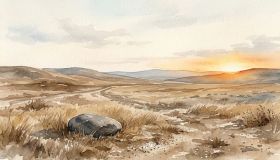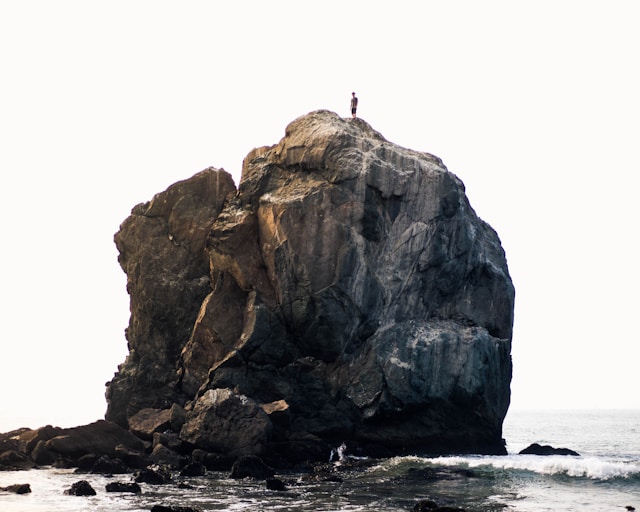
Psalm 61 says what many of us are afraid to say.
"From the ends of the earth I call to you, I call as my heart grows faint; lead me to the rock that is higher than I" (Psalm 61:2).
The psalmist is not performing strength here. He admits depletion. My heart grows faint. He also admits something most prayers avoid: that the help he needs sits above his reach. The rock is higher than I. He cannot get there by his own effort. He has to be led.
This is the prayer of an exhausted person.
If you have been treading water a long time, you know what it feels like. A moment arrives in chronic suffering when self-rescue stops being an option. You have tried the strategies and the verses and the practices, in good faith, exactly as faithful people are supposed to. Some helped a little. None of them finally lifted you out. You are at the end of what your own effort can produce.
The petition the psalmist gives you is not for strength to swim harder. It is for transit. It admits in advance that the destination is somewhere you cannot reach alone.
Being led to the rock does not, at first, feel like victory.
We imagine that the moment we reach it we will be standing on top, arms raised, the storm visibly receding behind us. The real version is quieter and much harder.
You reach the rock and you are not on top of it. You are at its base, clinging to the stone with both hands at eye level, the storm still crashing against your back. You have stopped drowning, and you have not started living. The rock is directly in front of your face. It blocks your view. You can see nothing except the cold wet surface of the stone you are pressed against.
This is the numb middle of being rescued, and almost nobody preaches on it.
If you are in it, you may have spent the season wondering whether you were rescued at all. You have not drowned, which is clear enough. But you cannot see God, or the future, or what comes next. You see only the immediate surface of survival, and survival feels like the whole world.
The rock has held you. You just cannot yet see what it has held you for. The numbness at the base is the unfilmed first act of the rescue.
The verse asks for more than the rock. It asks to be led to it, and leading implies movement. The supplicant is being taken somewhere rather than deposited.
The leading does not stop at the base. You are lifted, in time, though not all at once and often not in ways you could name. It is slow, and you usually notice only in retrospect, when you realise you are seeing more sky than you were a month ago. Some small piece of vantage has come back. The horizon, which the rock had blocked completely, is partially visible. In the distance you can see something that is not the storm.
The storm is still there. The lifting does not silence it, and most pastoral writing about rescue gets that wrong. The water goes on raging against the stone beneath your feet, and the conditions that put you on the rock are often still operating. The conditions have not changed. Your elevation has.
From the top, the storm is real and no longer your entire world. You can see that it has edges, and sky above it, and that the rock you are standing on is far larger than the small bit of stone you clung to at the base. You begin to notice other people on other rocks, also lifted, also seeing the storm from above rather than from inside.
The rock does not change the weather. From higher up, the same flood that was infinite becomes a flood with a shoreline.
If you are still at the base, clinging, unable to see, the practice today is to keep holding on.
Survival at the base is the whole work of this season. You do not have to climb or perform or see anything other than the stone in front of your face. The hands gripping the rock are doing exactly what they should be doing. The lifting will come, and the Lord who led you here has not finished leading.
Some days the only prayer available will be the psalmist's. Lead me to the rock that is higher than I. Said in a faint voice, with no theological flourish, and that is enough. God's people have prayed it from caves and prisons and kitchens at 3 a.m. for a very long time, and the rock has raised them.
It will raise you too.
The rock is real. The hands holding you are real. The vantage point is coming, even if today you cannot see past the stone in front of you.