When you pray for power, you are usually praying for speed.
You want the cavalry. You want the thundering arrival, the dust on the horizon, the charge that scatters the thing that has been crushing you. You want the depression gone by morning. You want the burnout lifted in a single restoring weekend. You want the family wound healed in one dramatic conversation. You want rescue that arrives fast, because fast is what the pain is begging for, and somewhere underneath, you have started to believe that if God loved you, he would hurry.
David names the instinct directly.
Some trust in chariots and some in horses, but we trust in the name of the Lord our God (Psalm 20:7).
Notice what the chariot and the horse have in common. They are both built for speed. They are the fastest, most dramatic military power available in the ancient world. When you wanted to scatter an enemy quickly, you reached for cavalry. The chariot was the helicopter of its day. It was rapid, visible, overwhelming, and immediate.
David sets that whole category aside. Some trust in chariots. The implication is that he does not. He trusts in something that does not operate at the speed of a charge.
The name of the Lord is power of a different kind, and it rarely moves like cavalry.
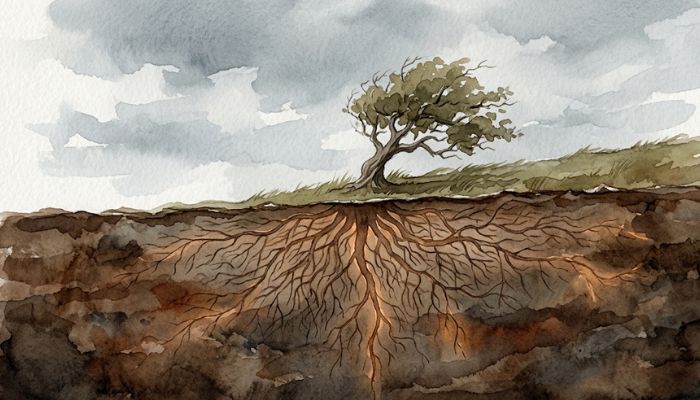
It moves more like a root system. Slow. Hidden. Underground. Doing its work in the dark where nobody can see it, over a timescale that has nothing to do with the speed you were praying for. A root does not arrive in a thundering instant. It grows, fibre by fibre, deeper and deeper, until one day the tree it holds can stand against a storm that would have flattened it before. Nobody watching ever saw the rescue happen. There was no dust on the horizon. There was only the slow, invisible work, year after year, until the strength was simply there.
This is closer to how God tends to rescue the crushed soul.
You were praying for the chariot. The power at work in you grows more like a root, slow and unseen, doing in years what you wanted done in a weekend.
The healing of a deep depression is rarely a charge. It is a slow returning, in increments so small you cannot feel them day to day, until you look back over a year and realise the ground you are standing on now is firmer than the ground you stood on then. The recovery from burnout is not a single restoring weekend. It is the slow rebuilding of a depleted system, the way a field left to rest slowly recovers its capacity to grow. The mending of a family wound is not, usually, one dramatic conversation. It is a thousand small acts of patience laid down over time, most of them invisible, none of them spectacular.
We equate the lack of speed with a lack of love. The verse asks us to unlearn that. The chariot is fast and shallow. The root is slow and deep. The slowness is not God withholding his love. It is the shape his love takes when it is doing something that lasts.
If you have been waiting for the cavalry and despairing that it has not come, the verse offers a quiet reframe.
The cavalry may not be coming. That does not mean the rescue is not underway. It may simply mean the rescue is the slower kind, the kind that grows rather than charges, the kind you will only be able to see once you look back from a distance and notice how far the roots have gone.
This asks something hard of you. It asks you to endure the slow, invisible metabolism of grace instead of demanding the immediate, spectacular evacuation. It asks you to trust a power you cannot see working, on a timeline you did not choose, in conditions that have not yet visibly changed. It asks you to stop measuring God's love by his speed.
The chariot trusters in David's day had something visible to point to. Horses they could count. Chariots they could parade. The person trusting the name of the Lord had nothing to show. Only an invisible God, working in an unseen way, on a schedule that looked, from the outside, like nothing was happening.
David staked everything on the slower power.
The roots, in time, held. The chariots, in time, fell. The name of the Lord outlasted them both.