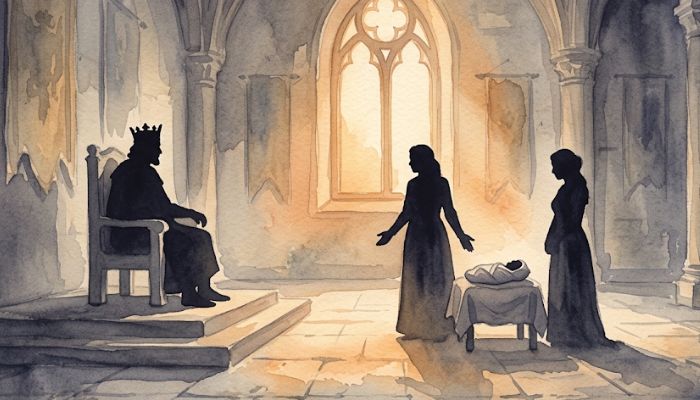
Two women stood before Solomon with one living baby between them. Both claimed him. He had no witnesses to call and no records to check, only the two women in front of him.
Solomon called for a sword.
"He then gave an order: 'Cut the living child in two and give half to one and half to the other'" (1 Kings 3:25).
He could not test which woman the baby loved. He could test which woman would rather lose him.
"The woman whose son was alive was deeply moved out of love for her son and said to the king, 'Please, my lord, give her the living baby! Don't kill him!' But the other said, 'Neither I nor you shall have him. Cut him in two!'" (1 Kings 3:26)
One woman would rather lose the child than watch him harmed. The other would rather watch him harmed than lose.
Any parent living through alienation knows that second voice. It comes as a visit that keeps falling through for reasons that change each time. It comes as a story about you, told in your absence, that your daughter now repeats back to you in words that are not hers. Losing costs that parent more than damaging the child does.
Most alienated parents eventually stop fighting through their children. They put down the counter-case. They stop asking the children to choose sides at the door.
From outside the house this looks like surrender. What the parent has worked out is the shape of the rope. The child is tied to the middle of it, and every honest pull tears him.
Friends call it giving up. Some days the parent suspects they are right.
The mother in Solomon's court would have looked the same to anyone watching from the doorway. She released her claim in front of the king and told him to hand the baby to the other woman. On the record, she lost.
Then Solomon ruled. "Give the living baby to the first woman. Do not kill him; she is his mother" (1 Kings 3:27).
Solomon hands the child back. The wise king is standing right there, and the yielding costs her nothing in the end. Your house has no Solomon in it. You let go and the silence carries on. Birthdays pass without a call, and nobody stands up to say what your stepping back was made of.
The ruling was never really about custody. Solomon did not make her a mother by handing her the baby. He read what her letting go had already shown him, and he said it out loud. She is his mother. She was his mother in the second she said give him away, before any king opened his mouth.
She released her grip. She did not release her son.
A parent who steps out of the tug of war has not stepped out of the child's life. Keep the light on, and keep sending the message that goes unanswered. Standing still costs more than fighting and looks like less.
You may never get the scene where someone with authority weighs what you gave up and says the true thing about you in front of everyone. That is a real loss. Pretending otherwise would not help you.
What you have instead came before any ruling. God watched you step back. He knows what it cost you, and why you chose it with nobody applauding. You let go so your children could live whole. He has already called that by its right name.