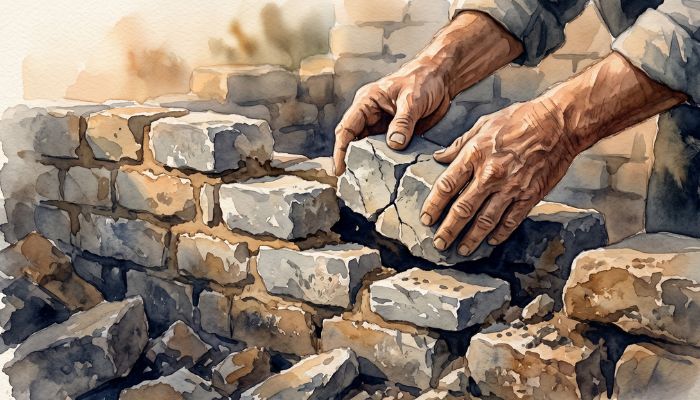
You have looked at the wreckage and assumed it was a total loss.
The fractured relationships. The years you cannot get back. The confidence that used to come easily and now does not come at all. You survey the internal landscape after a long hard season and it looks like a ruined city. Walls down, rubble where the structure used to be. You assume that if anything is ever built here again, the site will first have to be cleared, the broken material hauled away, something new and unblemished brought in from somewhere else.
Psalm 147 describes God's reconstruction work differently. "The LORD builds up Jerusalem; he gathers the exiles of Israel. He heals the brokenhearted and binds up their wounds" (Psalm 147:2-3).
The Lord builds up Jerusalem. Then, in the very next breath, he heals the brokenhearted. The two sit side by side deliberately, because in the psalmist's mind the rebuilding of a ruined city and the healing of a ruined heart are the same kind of work.
And Jerusalem, in this psalm, is a city coming back from ruin. The walls had come down, the temple had been destroyed, and the people had been carried off. When the psalm says the Lord builds up Jerusalem, it is not describing construction on a clean site. It is describing reconstruction on top of rubble, where the city fell.
He does not bulldoze the site and bring in perfect materials from elsewhere. He builds with what is there. The stones that were knocked down are the stones the new wall is made from. The rubble is the raw material.
Nehemiah's enemies understood this and thought it was ridiculous. Sanballat stood watching the work and asked, "Can they bring the stones back to life from those heaps of rubble, burned as they are?" (Nehemiah 4:2). The answer, visible in the wall that went up, was yes.
He heals the brokenhearted the same way. He does not replace the broken heart with a new one. He builds the new strength out of the pieces that shattered.
The fractures in you are not going to be hauled away and forgotten. The scar from the relationship that broke becomes, over time, the tenderness that lets you sit with someone whose relationship is breaking now. The confidence you lost becomes a humility more durable than the confidence ever was. The years you cannot get back become hard-won knowledge you carry into the years you do have. What you assumed was a total loss turns out to be the material.
None of that is a romantic gloss on suffering. The breaking was real. The loss was real. The ruin was a ruin, and the psalm does not pretend otherwise. Jerusalem really did fall. The heart really did break. What the psalm insists is that the ruin is the raw material for the architecture rather than the end of it.
If you have been waiting for a clean site before you let God rebuild, you may be waiting for something he never required. He is not waiting for you to clear the rubble. He is willing to build in it, and he is already building, in ways you may not yet see, out of the exact fractured pieces you assumed disqualified you.
The work is slow, as reconstruction always is. A city is not rebuilt in a week and a broken heart is not rebuilt in a season. You will, for a long time, be standing in something that looks more like a building site than a building. That is what the middle of reconstruction looks like. Rubble on the ground is evidence that the building is underway, with the only materials the site actually has.
Your brokenness is not the obstacle to what God is making of your life. It is the stone.
He gathers the exiles. He binds up the wounds. He builds the city back from the pieces that fell, and the wall that rises out of the rubble is, in its own scarred way, stronger than the one that stood before.