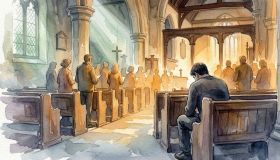
You have wanted a sign.
Not in a dramatic, fleece-on-the-ground sense. Something quieter and more desperate. You have wanted evidence that you are not the failure the loud voices have implied you are. You have wanted the depression to lift overnight, the situation to resolve in a way that vindicates you, the thing you have been carrying to be visibly taken off you, so that the people who judged your struggle would finally see that your faith was real all along.
Part of what you have wanted from the storm ending is what its ending would prove to your critics.
David wanted a sign too, and asks for one directly. "Show me a sign of your favour, that those who hate me may see and be put to shame, because you, LORD, have helped me and comforted me" (Psalm 86:17, ESV).
The second half of the verse is not what we expect. We assume a sign of God's favour would be something impressive. A victory over his enemies. A dramatic reversal. A display of power that silences the people who hate him.
What David actually points to is help and comfort. He asks for the sign standing on ground he has already been given: you have helped me, you have comforted me. Not that God made him invincible. Not that God removed every enemy. In the middle of being hated and worn down, David was held, and that holding is what he names as he asks.
You have been waiting for the sign to be the end of the struggle. The cure. The dramatic vindication. And because the struggle has not ended, you concluded the sign has not come, and because the sign has not come, you have wondered whether God's favour is on you at all.
The help and the comfort within the struggle are the evidence David is standing on. Which means the sign may have been arriving all along, in a form you did not recognise because it did not look impressive enough.
You got out of bed this morning when everything in you argued against it. That was help. The weight in your chest, while it has not gone, did not crush you. That was being held. You are still here, still treading water, still taking the next breath after a season that has cost you more than anyone around you knows.
Your survival is the sign.
The loud voices wanted flawless performance. They wanted you efficient and recovered and back to your old self, demonstrating by visible success that your faith was real. That is not the vindication God offers.
His is rawer and more stubborn. You are still standing. Not standing tall, perhaps, and not impressively, but standing. The bedrock under you has held. You have been helped and comforted in ways too small for anyone else to notice, and the cumulative weight of all that small help is the simple fact that you have not gone under.
To critics who measure faith by performance, this will not look like much. They are watching for the parted sea, and a person who merely survived will not impress them.
You did not hold yourself, though. You could not have. The help came in a thousand small forms, and the help is the sign of his favour, exactly as David named it.
It looks like the fact that you are still here.