You did something great yesterday. Or you survived something hard. Either way, you woke up today with nothing left, and you cannot understand why.
Elijah could not understand it either.
The day before, he had stood on Mount Carmel and watched fire fall from heaven. Four hundred and fifty prophets of Baal had called on their god from morning to noon, cutting themselves, shouting, and getting nothing. Elijah soaked his altar in water until the trench overflowed, prayed one short prayer, and the fire of the Lord came down and consumed everything, even the water. The greatest day of his ministry. A triumph by any measure.
Then Queen Jezebel sent one messenger with one threat, and Elijah ran.
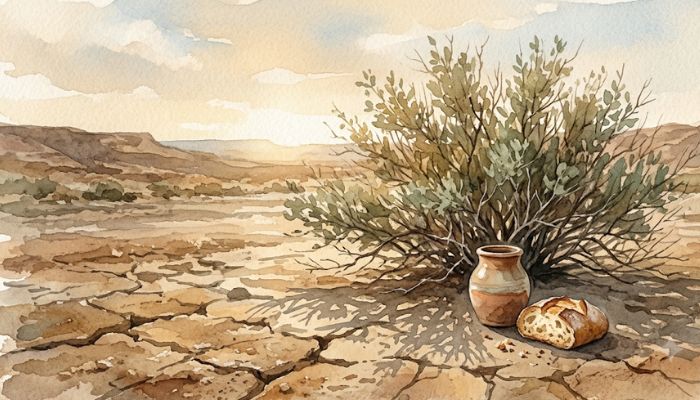
He ran south into the wilderness, left his servant behind, and went on alone until he came to a single broom bush. He sat down under it and asked to die.
"I have had enough, Lord," he said. "Take my life; I am no better than my ancestors." (1 Kings 19:4)
One threat. One day. That is all it took to move a man from fire on the mountain to a wish for the grave. From the outside he looked like he was winning. Inside, he was already at the edge, and no one saw it, because that is how it works. The distress does not show until it does. If Elijah walked into a clinic today we would use the word suicidal, and we would have missed it entirely the day before, when he still looked triumphant.
Maybe you know that gap between how you look and how you are.
Here is what strikes me about the story. God does not arrive with a speech. He does not remind Elijah of the fire, does not scold him for running, does not hand him a recovery plan. Elijah lies down and sleeps, and while he sleeps, God sends someone to touch him on the shoulder.
"All at once an angel touched him and said, 'Get up and eat.'" (1 Kings 19:5)
Bread baked over hot coals. A jar of water at his head. God meets Elijah where he is, not where he is meant to go next. He meets the need before he touches the purpose.
And then Elijah eats, drinks, and lies down again.
That detail matters more than it looks. One meal does not fix him. He is so depleted that the only thing he can manage afterward is to sleep again, and instead of pulling him up, the angel comes back a second time.
"Get up and eat, for the journey is too great for you." (1 Kings 19:7)
Notice that God is not in a hurry. He does not stand over the exhausted man with a stopwatch. Elijah is not ready to be sent anywhere; he is only ready to rest, and God accepts that. He does not shame the exhaustion. He feeds it, twice, because once was not enough.
The broom bush itself tells you something. It is the desert shrub that grows in dry riverbeds, and it throws a thin, patchy shade, barely enough to cover a man lying down. Not a garden. Not a reward. The one scrap of shelter in a hard, dry place. And that is exactly where God comes to meet him.
You may be under a broom bush right now. You may not be able to name what you are carrying, only that you have run a long way and cannot take another step. If that is you, hear what God did not do. He did not explain the burnout. He did not resolve the crisis that afternoon. He gave a tired man bread, water, and rest, and let that be enough for one more night.
Strengthened by that food, Elijah eventually got up. "He travelled forty days and forty nights until he reached Horeb, the mountain of God." (1 Kings 19:8) The road came later. First came the shade and the meal and the second touch on the shoulder.
The rest was real. The food was real. And because they were real, the journey became possible.
You do not have to stand up today. You do not have to name the road ahead or find the strength for it yet. For now it is enough to eat, to drink, to let yourself be met under whatever thin shade you have found. The One who fed Elijah has not lost sight of you. He is not measuring how fast you recover.
You are still here, under the bush, being fed. That is not a small thing.
May you be blessed by the following song inspired by Elijah under the Broom Bush.