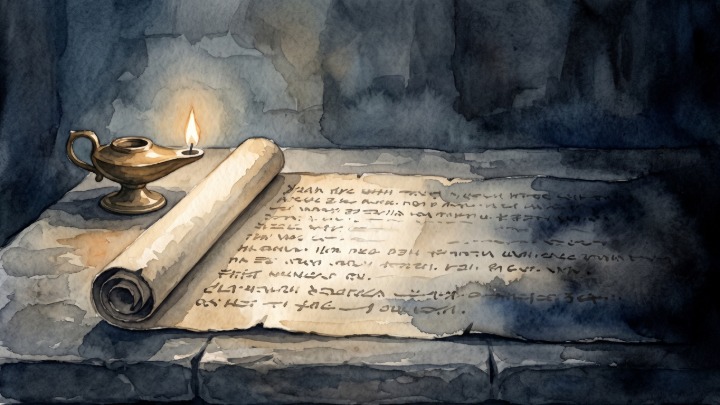
Psalm 88 does not resolve, and the strangeness of that is on the page itself.
Read the Psalter from beginning to end and you notice a pattern. The laments, and there are many, almost always turn. Somewhere in the middle or near the end the psalmist says but or yet, and the prayer pivots. "But I trust in your unfailing love; my heart rejoices in your salvation" (Psalm 13:5). "Yet I am always with you; you hold me by my right hand" (Psalm 73:23). The dark is real, and the dark is not the last word. That pivot is what makes a lament psalm a lament psalm, a small structural promise that even the worst prayers eventually find their way to yet.
Psalm 88 has no pivot. It goes into the dark in verse one and stays there for eighteen verses. "You have taken from me my closest friends and have made me repulsive to them. I am confined and cannot escape; my eyes are dim with grief" (Psalm 88:8-9). "Why, LORD, do you reject me and hide your face from me?" (Psalm 88:14). And then the last line, where the Hebrew word mach·shakh, darkness, is literally the final word of the psalm.
The song ends mid-cave, and nobody lights a candle.
They had compiled and arranged a hundred and fifty psalms and understood the formal expectation better than anyone. Laments were supposed to turn. They could have edited this one. A single appended verse, a yet, O LORD, I will hope in you, and the psalm would have read more comfortably for every generation since.
They did not. They left it in the dark, because they believed something the modern church has mostly lost: that the Bible was not only for the believer who had already made it out. It was also for the believer who had not. The one for whom the yet had not yet come. The one who, on a particular Tuesday, could not honestly say "but I trust in your unfailing love," and needed a prayer that did not require them to say it.
Psalm 88 is that prayer. It sits in the canon as God's permission for unresolved prayer.
You do not have to manufacture the pivot. The pivot is not the test of your faith, and your faith does not hang on your ability to produce, at the end of a prayer, the small redemptive turn that closes a lament neatly. Sometimes the prayer ends where the pain ends, which is to say it does not end at all.
The Bible has a prayer for the day you cannot find the yet.
In the Holy Spirit's own songbook there is a song for the worship leader who can no longer sing the resolving songs. For the parent whose grief has not lifted in three years. For the chronically ill person who has stopped saying "I know God will heal me" because they no longer know it. For the believer who has been in the cave long enough to wonder whether the cave is now their address.
The song does not pretend the cave is beautiful, or promise it will lift by Tuesday. It says: I am in the cave. I have been calling and you have not answered. And then it stops.
God's people have read that psalm and said amen for longer than there has been a church. That witness is available to you.
The pivot may still come. Many believers find, over the long run of their lives, that the yet arrives, not always in the situation they were praying about but in some other corner of the soul that has slowly learned to trust again. The lament psalms that do resolve give us language for those days, and they are gifts.
The days when the yet does not come are not days when faith has failed. They are days when faith looks like Psalm 88, a prayer that keeps the address even when it cannot find the resolution.
You are allowed to pray that prayer. Until the pivot comes, the prayer that does not resolve is also a prayer.
Part 1: Darkness is my Closest Friend
Part 2: The Psalm that does not resolve
Part 3: The Anger that keeps Praying
Part 4: When the Community Steps Back