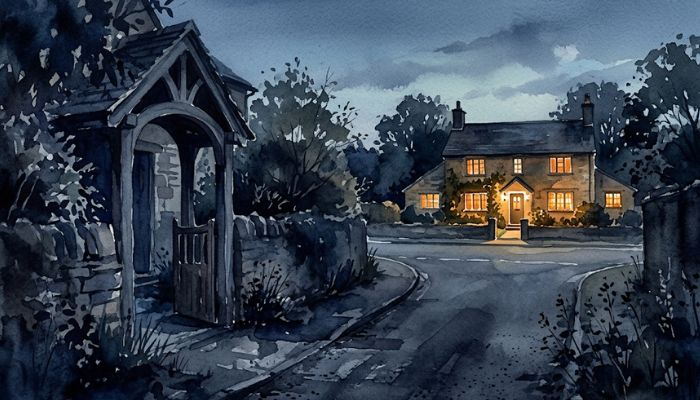
You know the house. You have never been inside it, but you can see it clearly enough.
It looks whole. A table that seems full. Photographs where everyone is smiling and you are not in the frame. On a day like this one, the day set aside for fathers, you can almost hear it from where you stand: the ordinary warmth of a family that has closed around your absence and learned to look complete without you. And something in you bows to it. You look across at that house and its splendor, and you feel the size of your own quiet room by comparison.
"Do not be overawed when others grow rich, when the splendor of their houses increases" (Psalm 49:16).
We usually file that verse under money. But splendor wears other clothes. For a parent shut out of a child's life, the splendor that overawes you is not wealth. It is the appearance of an intact family, carrying on, apparently fine, while you sit outside it holding a love that has nowhere to go.
The danger of looking across is not the looking. It is the conclusion you draw from it.
You see the lit windows and you decide they mean something about you. If they can be whole without you, the logic runs, then you must have been the broken part. Their wholeness becomes the proof of your failure. The fuller that house looks, the smaller and guiltier you feel, until the warmth coming from it is no longer just their warmth. It has become a verdict passed on your worth.
Psalm 49 walks straight up to that verdict and refuses it. Read on a few lines and the psalm says plainly that no splendor can ransom a soul, that the house however impressive cannot finally redeem anyone inside it. Which means the brightness in those windows is not the measure of anything eternal. It is a scene, and scenes are arranged. You are seeing the side that faces the street.
The house that looks whole from the outside is not a sanctuary because it looks whole. You are reading a verdict into a window, and the window cannot pronounce one.
A family can look complete and still be carrying things no photograph shows. Distance learned as self-protection. A child taught that you were dangerous, performing an ease they may not feel. You do not actually know what that house holds. You only know what it broadcasts. And the psalm's whole point is that the broadcast is not the truth of a soul.
So the warmth across the way is not a courtroom, and you are not on trial in it.
Your worth as a father was never going to be settled by which house looks fuller on the third Sunday of June. It does not hang on whether the table over there appears whole. It rests on a covenant you made and have not abandoned, on a love you keep alive in a room with no one in it to receive it. That is not nothing. Held quietly, unwitnessed, unapplauded, it may be one of the truest things a father can do.
So you can stop bowing to the other house. You can let it be lit and warm and complete-looking and still not let it tell you who you are. The splendor over there cannot ransom a soul, theirs or yours. And your child, wherever they sit tonight, in whatever house has closed around your absence, is still held. If not by your arms today, then by arms no house can shut out.
You are still here, and still a father. On this day above all, that is not a small thing.