Somebody handed you a word once. A teacher, maybe. A parent. A doctor with a folder open on the desk. Lazy. Difficult. Too much. The sick one. You pushed back the first time, and probably the second.
Then you stopped pushing.
Labels work by repetition. The word stops sounding like an accusation and starts sounding like information. You plan around it. You decide in advance what you can hope for and what you had better not. You introduce yourself by it, sometimes out loud, more often in the commentary running quietly underneath everything else.
We forget they were ever applied, that is the odd part. Wear one long enough and it stops feeling stuck on. It feels grown in.
David writes about where he came from, and he takes his time.
"For you created my inmost being; you knit me together in my mother's womb. I praise you because I am fearfully and wonderfully made; your works are wonderful, I know that full well" (Psalm 139:13-14).
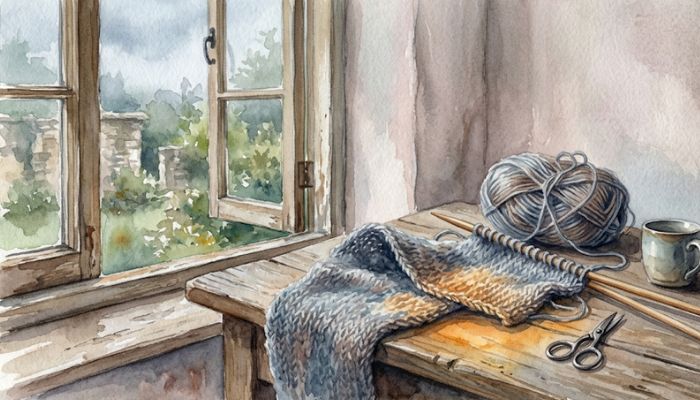
Knitting is slow work. Done by hand, one loop at a time. Nobody knits in a hurry, and when a stitch goes wrong the knitter does not bin the whole piece. She works it back in.
David does not say God assembled him on a line and moved on to the next one.
A label says you came out wrong. Your Maker says you were made with care, by hand, on purpose.
That claim contradicts what the label tells you, and one of them is lying. The label reports on a season. It saw a bad stretch, or a collapse, or a refusal you could not explain to anyone, and it named the whole of you from that fragment. Somebody looked at one crack and called the entire bowl rubbish.
The psalm never tells you the crack is imaginary, though. David is not writing propaganda about how fine everything is; he is the same man who wrote about tears wetting his bed at night. He holds both, which is why you can trust him.
The first half of the psalm is harder to receive than the second.
"You have searched me, Lord, and you know me. You know when I sit and when I rise; you perceive my thoughts from afar" (Psalm 139:1-2).
Searched. Not glanced at. Gone through carefully, the way you go through a house looking for something small.
Most of us hide because we have learned what happens when people find out. They find out and they leave. So we show the presentable parts and bury the rest, and we call it privacy when it is fear. Being fully known has usually cost us something.
Then David writes this: "You hem me in behind and before, and you lay your hand upon me" (Psalm 139:5). Not a fist. A hand laid on a shoulder, the way you steady someone who is about to fall.
He searched the whole of you, including the part you have never said out loud. And He did not leave.
The people who labelled you did not know you. They could not have. They had a surface and made a ruling from it. The One with access to everything, the buried thing and the worst night and the thought you would be ashamed to repeat, stayed.
David goes into the dark too, because he knew it: "If I say, 'Surely the darkness will hide me and the light become night around me,' even the darkness will not be dark to you" (Psalm 139:11-12). He knew the wish to disappear for a while, to pull the blanket over his head and let the world forget him. That wish sits in Scripture, held by a man God loved. If you have felt it, you are standing where David stood.
Your worst night is not a room where God loses track of you.
Probably nothing dramatic. You will not stop believing the label this afternoon because you read a psalm this morning. Labels come off the way they went on, slowly.
You can start noticing which voice is speaking, though. When the word arrives at two in the morning with its old certainty, you can ask where it came from and who handed it over. You can hold it against what your Maker said and see which one has the better claim to know you.
The person who labelled you had a fragment. He had the whole.
You are carrying a word that somebody else chose. It was never your name.