Ask most people what joy is and they will describe a clear day. An empty calendar, a tidy house, nothing going wrong. Joy, in that telling, is what arrives once the trouble leaves.
If you have ever been in a long stretch of suffering, you already know how useless that definition is. Wait for the trouble to leave before you let yourself feel anything good, and you will be waiting a very long time. Your soul will starve while it waits. Joy that only works on clear days is no use to anyone living through a storm, which is to say it is no use to most of us, most of the time.
Habakkuk knew this. The prophet wrote one of the most defiant sentences in all of Scripture, and he wrote it staring directly at total ruin.
"Though the fig tree does not bud and there are no grapes on the vines, though the olive crop fails and the fields produce no food, though there are no sheep in the pen and no cattle in the stalls, yet I will rejoice in the Lord, I will be joyful in God my Savior" (Habakkuk 3:17-18).
Notice what he does not do. He does not look on the bright side. He does not tell himself the famine is a blessing in disguise. He names it, item by item, the full inventory of loss. No figs. No grapes. No sheep. In his world that was not disappointment, it was starvation.
You are allowed to do the same. You do not have to dress your suffering up as a gift you have not unwrapped yet. People will often press you to find the silver lining, and there is something almost insulting in being told to smile through it, as though the size of your pain embarrasses them. You can sit with the empty fields and say plainly that they are empty. Habakkuk did. Honesty about the ruin is where his joy starts, not where it fails.
And read the verse just before, because it matters. He says his body trembled, his lips quivered, decay crept into his bones (Habakkuk 3:16). The man who wrote "yet I will rejoice" was shaking when he wrote it. The joy did not replace the fear. It came up through it.
Joy is not the absence of the mud. It is the presence of the witness.
Everything pivots on "yet."
It is not a feeling. It is not a mood that descends if you are spiritual enough. It is a decision, made with a trembling body, to not let the ruin have the last word. The "yet" is the unexpected, almost inappropriate laugh that escapes between two friends when the plan has completely fallen apart. It is the small, stubborn refusal at the bottom of a bad night. The storm can take your energy and wreck your plans, but you are deciding, here, that it does not get your soul.
And notice where Habakkuk fastens that joy. Not to the harvest coming back next year. Not to the fields filling again. He ties it to God, full stop, the one standing with him in the wreckage. This is the whole secret of it. If your joy depends on the diagnosis improving, the anxiety lifting, the conflict finally resolving, then the storm holds you hostage and joy stays just out of reach. But joy that rests on not being alone in the dark does not need the dark to end first.
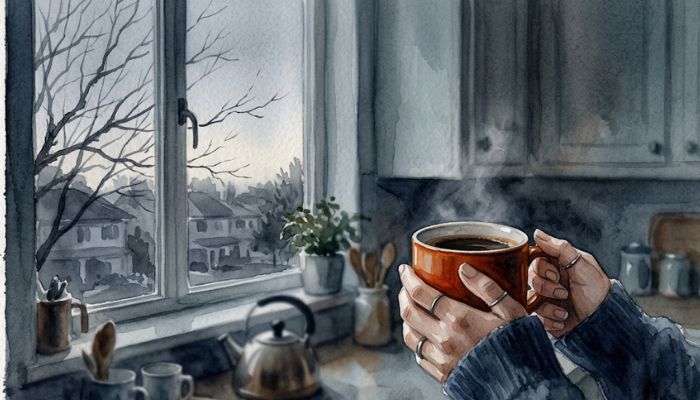
That kind of joy is not a feast. It is more like one concentrated mouthful of food in the middle of a long fast. It is not meant to fill you. It is meant to keep you standing for the next hour. The warmth of a coffee made slowly with your own hands. A quiet half-hour claimed in a corner where no one needs anything from you. You take that one small, real moment of peace, and you let it carry you to the next wave.
The clear-day version of happiness needs the sun out and the fields full. This other kind, the kind that survives, needs only one thing. Someone in the dark with you, who does not leave.