Somewhere in the first verse of "Green, Green Grass of Home," a man steps off a train into the town where he grew up. His mother and father are waiting. A girl with gold hair runs down the road to meet him. The whole song sounds like a homecoming, soft and warm and safe.
If you are missing someone, that first verse is your whole interior life.
You did not know you were living in the green grass. Nobody tells you that part. The ordinary evenings did not come with a warning that they were the good years. You were tired, or distracted, halfway through the dishes, and their voice came from the next room the way it always did, and you answered without turning around. You thought there would be more of them. You never counted, because you never imagined the counting would stop.
Now you would give almost anything to stand in that kitchen again and turn around when they spoke.
The memories come back with a sharpness that feels unfair. The weight of them next to you. The joke that meant nothing to anyone else and everything to the two of you. The way a house with them in it held more than one heartbeat, so that even the quiet felt like company. You keep it in your body more than your mind. You reach for the phone before you remember. You set the second cup down before you remember. A car slows in the drive and something in your chest lifts for half a second, before the rest of you catches up and puts it down again.
The hope is the worst of it, because you cannot switch it off. It runs under everything, low and constant, like a pilot light. Some part of you is still waiting for the train. You picture the door opening and it is them, and the strangeness is finally over, and the whole long ache of their absence just collapses into the fact of them standing there. You have run the scene so many times it has gone smooth at the edges. It is the last thing in your head before sleep and the first thing waiting in the grey light.
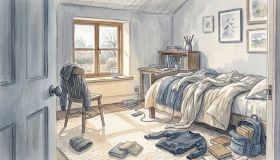
Then the song turns. The man wakes to four grey walls and understands he was only dreaming. He was never on a train. He is in a cell, and the only way back to the green grass is under it, when they bury him there.
Every morning you wake to the grey walls.
They look different for each of us. For one it is a blocked number and a silence where a voice used to be. For another it is the cold half of the bed, or a door kept shut because opening it costs too much. For someone else it is a name that changes the whole room when you say it out loud, so you have learned not to. Either way, you get pulled out of the green grass and set back down in the house as it is now, with the shape of them still marked out in the air.
Then memory turns on you. It does not sit still and wait to comfort you. It gets argued with, or rewritten, or it simply stops fitting the life you now live in. You look at the same photographs, walk the same rooms, and you understand that the door back into that place is shut, and wanting it open does not open it.
You are asked to grieve at a funeral with no flowers, for a loss the world has no ceremony to hold.
Some griefs come with casseroles and cards and a room full of people who came to sit with you. This one does not. The chair is empty and nobody else seems to notice. Everyone moves at their ordinary speed while you stand still in a house that has quietly changed shape around you.
Most laments in the Bible bend toward the light before they finish. The writer weeps through eleven verses and then remembers God is good and lifts his head. We love those endings. We reach for them, because we want the ache to be a phase.
Psalm 88 refuses. It is the one prayer in the whole book that never turns. The writer tells God, "I am overwhelmed with troubles and my life draws near to death" (Psalm 88:3). He does not soften it: "You have put me in the lowest pit, in the darkest depths" (Psalm 88:6). He is honest to the edge of accusation, and he will not tidy himself up to make God more comfortable. Then the psalm ends. Its last words are these: "darkness is my closest friend" (Psalm 88:18).
No sunrise slipped in at the close. No resolution. The prayer just stops, in the dark, still talking to God from inside the grey walls.
That psalm is in the Bible on purpose. A whole people kept it, sang it, prayed it, so that the person who cannot find the light would have words that do not lie to them. You are allowed to end the day here. You are allowed to wake tomorrow and end it here again. The green grass was real. The person was real. The missing is real, and it does not have to be fixed tonight to be held by God.
You wake to the grey walls. You are still speaking into them. Somehow, in the dark, that is still a prayer.