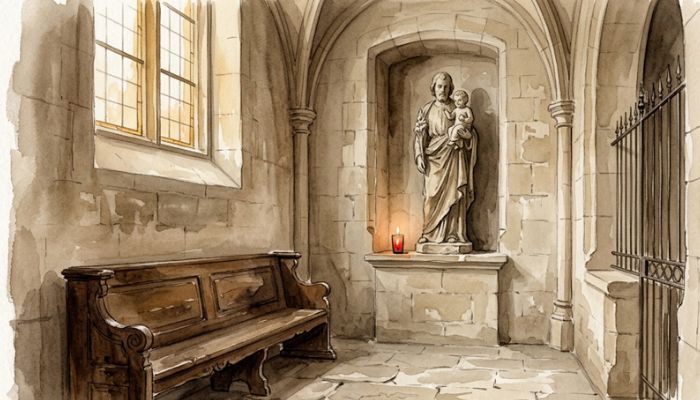
You can find him in a quiet church if you go looking. A side chapel, a statue worn smooth, Joseph holding the boy or holding his tools, always slightly to one side. Even in stone he stands just outside the frame.
Maybe that is why a parent who has been pushed out of a child's life ends up in front of him, in a church far from home, on a day that names you father and gives you no one to say it to. Of all the days, this one. You go where home cannot follow you. You sit with the one saint who knows what it is to love a child he could not keep at the centre of his own story.
Joseph raised the Christ and got no angel each morning to tell him he was doing it right. He had a few dreams, then the daylight, where timber had to be cut and a boy had to be taught to hold a chisel and choices had to be made with a very human heart and not enough information. He tucked in a child who got splinters and woke from nightmares, and once lost him for three days in a crowded city. How do you think he slept those three nights? Replaying every decision, weighing every moment he might have watched more closely. That is the inner life of an alienated parent on most days.
People call him the father in the shadows. Not absent. Just willing to be unseen so the boy could be seen.
Shadows are lonely, though.
Fatherhood is not the same as being seen nearby. It is a covenant held in the heart, a yes spoken before God over a child.
He stood in shadows he chose. Yours were forced on you. He knew the ache of feeling inadequate. You know the ache of being shut out. He was given a child and a home and asked to love inside that space. You were given a child and then walled off from one, asked to love across absence and suspicion and lies you never told.
A particular shame travels with that. Not only the pain of not being there, but the slow suggestion underneath it that your absence is the proof. Proof you were never a real parent. The paperwork, the withheld contact, the stories told in rooms you were never allowed to enter, all of it stacks up like evidence in a trial where you never got to speak. And in the long quiet, the accusation starts to sound like fact. If you were a good parent, you would be there.
Then you look back at the man in the corner of the chapel, and something moves.
He lived inside realities he never chose. A census that dragged his family across the country at the worst possible time. Violence that sent them fleeing to Egypt in the dark. If fatherhood were measured by control, Joseph failed it outright. Frightened kings and distant emperors wrote most of his story. His greatness was never control. It was faithfulness inside a story handed to him.
So your calling has not ended. It has only changed shape. From hands-on shaping to a waiting that costs everything. From daily presence to daily intercession. From building with wood to building with tears and words no one will ever see. Joseph could not shield the boy from every wound either. His task was never to guarantee the outcome. It was to be faithful in what he could do and to trust God with what he could not.
That is the word he hands you across two thousand years. Not flawless. Not powerful enough to mend what is broken. Faithful, in the space that remains. He keeps you from collapsing your whole self into the word "failure" and turns you, gently, toward "father" instead.
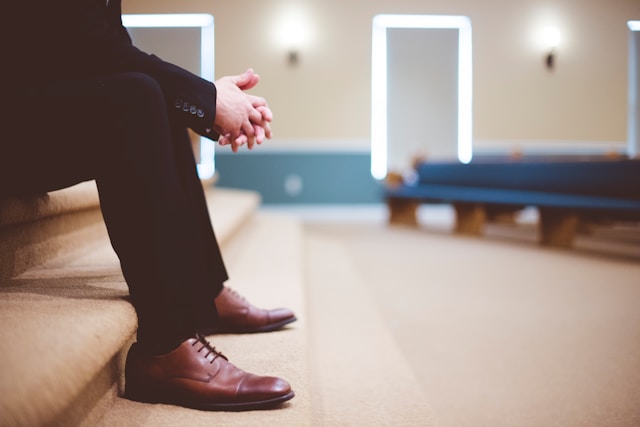
So you sit a while longer in the cool of the church, far from a home too painful to be in, on the day the world sets aside for fathers, and you bring it all to God the way Joseph must have. Unsteady hands. A tired mind. A heart hopeful and afraid in the same breath. You ask him to guard the child you cannot guard, and to keep your own heart from hardening while you wait.
And in that asking, barely whispered, you are not only a parent aching for a child out of reach. You are standing beside Joseph in the shadows. The child is still held. If not in your arms today, then in arms no conflict can keep away.