You have tried to hope. You have made yourself read the promises, the ones underlined years ago in a different season, back when they still meant something. You have said them out loud in the dark, slowly, the way you were taught, waiting for something in your chest to lift. Nothing lifted. The words came out and fell, like coins dropped into a machine that no longer runs. And in the quiet after, you began to wonder whether the problem was the words, or whether the problem was you.
The psalmist in Psalm 71 is old. His strength is failing. Enemies are watching him and saying that God has forsaken him, and the worst part is that he cannot fully argue with them. He has no tidy answer. He keeps talking to God anyway, and in the middle of all of it he says this:
"But as for me, I will always hope; I will praise you more and more." (Psalm 71:14, NIV)
He says he will hope. He does not say he feels it. The line sits in the psalm as a thing he is setting himself to do, not a thing already in his hands.
Most of us were taught that hope is a feeling, or a decision, or the natural result of believing the right things hard enough. When it doesn't come, that teaching turns on us. We decide we are not believing hard enough. We decide our faith has quietly drained out while we were not paying attention, and that everyone can see it but us. The shame of that is its own kind of exhaustion. You are not only tired. You are tired and convinced the tiredness is your fault.
Look again at the old man in the psalm. He does not work up his hope. He asks God to act. Rescue me. Come quickly. Do not be far from me. Every line turns outward, toward God, not inward, toward himself. He is not standing in front of a mirror trying to summon a feeling. He is calling across the room to someone he believes is still there.
Hope is not what you produce when you finally get your faith right. It is what God forms in you when you keep showing up.
This is the turn the long middle asks of you, and it is gentler than the one you have been attempting. Stop trying to generate hope from inside a body that has nothing left to give. Ask for it instead. "Teach me to hope" is a prayer the psalmist never says in those exact words, and yet it is the shape of everything he does. The whole psalm is one long asking God to make possible what the man cannot make possible alone.
You are allowed to tell God that hope has run out. You are allowed to say that the phrases have stopped working, that the promises feel like they belong to someone else, that you have tried to make yourself feel what will not come. None of that is a failure of faith. It is the oldest kind of prayer there is, older than the cheerful ones, and God has been hearing it for a very long time.
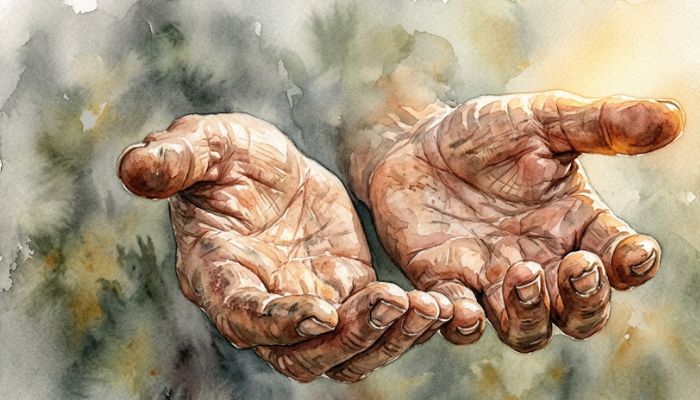
The psalmist's "I will always hope" is not a man holding hope in his hands. It is a man who has decided to keep reaching for it in the dark, to keep speaking to the God who gives it, even when his reaching closes on nothing. That is what faith looks like this far down the road. Not certainty. Open hands.
So open yours. You do not have to fill them first. You do not have to arrive with anything. Bring them exactly as empty as they are, and ask.
The road is long. You are not alone on it.