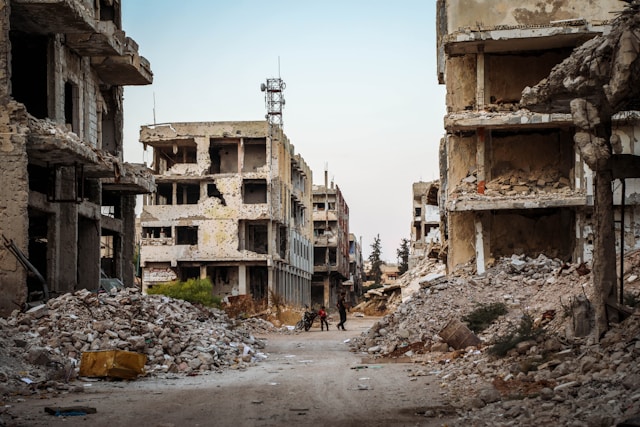
You have been reading the news the same way I have. The strait closed. Tankers stranded. Thousands of mariners trapped on ships they cannot leave. A ceasefire that holds for a few days and then does not. The price of oil moving with every headline, the price of food moving with the price of oil, and the small mathematics of your household budget being redone at the kitchen table on a Tuesday night.
You are not imagining it. The world is measurably less stable than it was. Inflation is not in your head. The war is not in your head. The quiet dread you feel when you open the news app and brace yourself before the headlines load is your body keeping accurate score of the times you are living in.
This uncertainty is the world the Bible was written for.
Most of us, if we are honest, have been working with a different assumption. Stability is the baseline and instability is the disruption. Ordinary life is the long stretch of peace, and war and famine and inflation and uncertain futures are the interruption. The news app is bringing us bad days inside an otherwise good era.
Neither history nor Scripture supports that. The era of cheap oil and uncontested borders and predictable supply chains, in which most Western Christians have done most of their formation, was the interruption. It was the unusual stretch. What we are watching now is the world returning to the conditions the church has lived in for most of its two thousand years, and inside which most of the Bible was written.
So the Scriptures are not comfort offered from a safe place to those of us in trouble. They are letters written from the same trouble, by people on the same ground, who learned something in it that we are now being given the chance to learn too.
Many of us reach for this psalm in seasons like this. "God is our refuge and strength, an ever-present help in trouble" (Psalm 46:1). What we tend to skip is the next sentence. "Therefore we will not fear, though the earth give way and the mountains fall into the heart of the sea, though its waters roar and foam and the mountains quake with their surging" (Psalm 46:2-3).
The psalmist is not describing weather. He is describing, in the most extreme imagery his cosmology gave him, the entire created order coming apart. Mountains were the picture of solidity. The sea was the picture of chaos. He is watching one fall into the other.
And his conclusion is not that the earth will hold. It is that we will not fear, even if it does not.
The first promise is the one we wanted. The second is the one we have been given.
Habakkuk goes further. He ends his small book by writing, "Though the fig tree does not bud and there are no grapes on the vines, though the olive crop fails and the fields produce no food, though there are no sheep in the pen and no cattle in the stalls, yet I will rejoice in the LORD, I will be joyful in God my Savior" (Habakkuk 3:17-18). The economy of his world has collapsed. The vineyard, the orchard, the field, the flock, every source of his livelihood named and itemised and crossed out. In the empty space where his security used to be, he finds that joy in God was never a function of the harvest. It was the God who, harvest or no harvest, was still his.
This is the territory the church has crossed repeatedly, through plague and persecution and economic ruin and the rise and fall of empires. The abnormal thing was the half-century in which the Western church mistook a particular geopolitical arrangement for the kingdom of God. The kingdom was always something else, a kingdom whose stability was located, irreducibly, in a person rather than a polity.
That person, on the night before a state killed him, said this: "In this world you will have trouble. But take heart. I have overcome the world" (John 16:33).
He did not say the trouble would stay away, or that his followers would be insulated from the chaos of their moment. He said two things in the same breath. The trouble is real, and it does not have the last word.
The overcoming he meant was not the overcoming of empires by other empires. An empire was about to kill him. He meant something deeper: the overcoming of death, and of the power the unstable world holds over the human heart, and of the fear that says if the conditions go, I go with them. He was about to demonstrate in his own body that something in the universe goes through the worst the unstable world can do and comes out the other side alive, with the wounds still visible, offering his hands to be touched.
That is the only refuge that has ever finally held. It was the refuge offered to the church at Smyrna, told to expect suffering and given this instead of rescue: "Be faithful, even to the point of death, and I will give you life as a victor's crown" (Revelation 2:10). It was the refuge of believers in occupied Holland, in Soviet prison camps, in famine-stricken villages where the harvest did not come. It is the refuge available in the small flat where you read the news this morning, with the price of bread doing what it is doing.
The strait may close again. The ceasefire may not hold. I cannot promise you the world is about to settle.
I can promise what the saints have always been promised. The Lord who walked through his own unstable hour and came out the other side bearing the marks is here. Not after the conditions improve. Now, in the conditions you actually have.
The mountains may fall into the sea. He will not.