You can probably name the number. Eighteen months since the diagnosis. Four years since your mother last said your name and knew who you were. Long pain makes people more aware of the time.
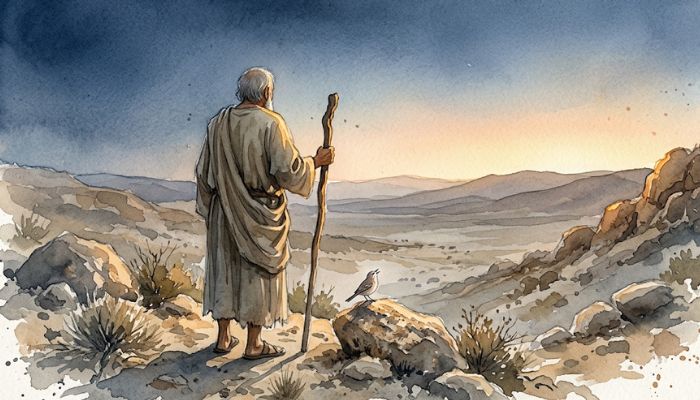
Moses could name his number too. He spent forty years in the wilderness and watched a whole generation die there. Psalm 90 is his prayer, and it reads like the work of a man who had buried most of the people he set out with.
He does not hurry past the grief. "All our days pass away under your wrath; we finish our years with a moan" (Psalm 90:9). A verse later he does the plain mathematics of a human life: "Our days may come to seventy years, or eighty, if our strength endures; yet the best of them are but trouble and sorrow, for they quickly pass, and we fly away" (Psalm 90:10).
Life is short, and Moses says so without flinching. Yet the hard days inside that short life can feel endless. Earlier in the psalm he tells God, "A thousand years in your sight are like a day that has just gone by, or like a watch in the night" (Psalm 90:4). A night watch was a guard's shift of a few hours. To God, a thousand years pass that quickly. If you have lain awake at three in the morning, you know it works the other way for us. A few hours of the night can feel like a thousand years.
Then Moses begs God to stop: "Relent, LORD! How long will it be? Have compassion on your servants" (Psalm 90:13).
Two verses later he asks God for gladness to match the pain: "Make us glad for as many days as you have afflicted us, for as many years as we have seen trouble" (Psalm 90:15).
Moses could have blamed the desert for those years. He names God instead: "as you have afflicted us."
That phrase is hard to read from inside the hard days. It can stir an old fear that your depression or your loss is a punishment God handed down for something you did. Moses makes no attempt to explain the reason. He takes the blame and the request to the same God: if you sent these hard days, you can send glad ones too.
He would rather wrestle with a God who let this happen than live in a world where no one is listening. That is a form of trust, even when it sounds like a complaint.
Moses would rather wrestle with a God who let this happen than live in a world where no one is listening.
Relief would have been enough for most of us. Moses asks for more: "Satisfy us in the morning with your unfailing love, that we may sing for joy and be glad all our days" (Psalm 90:14). He wants the morning to come soon, and he wants to sing.
When we hurt for a long time, our prayers often shrink. We ask for strength to get through the day, or for one decent night's sleep. Those are good prayers, and God hears them. Moses prays bigger. He asks for gladness, as many glad days as he has had hard ones.
Some of us feel guilty asking for joy. It can seem selfish while others suffer, or shallow when life is this serious. Psalm 90 corrects that. A man who had buried his generation begged God for happiness, and nothing in Scripture rebukes him for it.
Glad days are rarely dramatic. A glad day might be a morning when the heaviness is not the first thing you feel. It might be a moment when you laugh at something.
Most joy arrives in ordinary portions. Your morning coffee tastes like coffee again. Afternoon light falls across the floor, and you stop long enough to see it. A friend sends a message about nothing in particular, just a photo of something that made them think of you. Your children ask you for something, and you are glad to be asked.
In long pain, moments like these can seem too small to pray for. Moses asked to be glad "all our days" (Psalm 90:14), and most days are built from moments this size.
If depression has flattened your joy, you may not be able to imagine feeling glad again. You can ask for gladness before you can feel it. Moses prayed this psalm while he was still in the wilderness, with the graves of his generation along the road behind him.
You can ask for gladness before you can feel it.
Moses died on a mountain, looking across at a land he never entered. We cannot say whether his glad days came in his lifetime. His people crossed the Jordan soon after, and God answered part of his prayer through them.
God let these hard days come. God also kept this prayer in his own book, a prayer that asks him for joy plainly and without apology. He would not have kept it if he minded being asked.