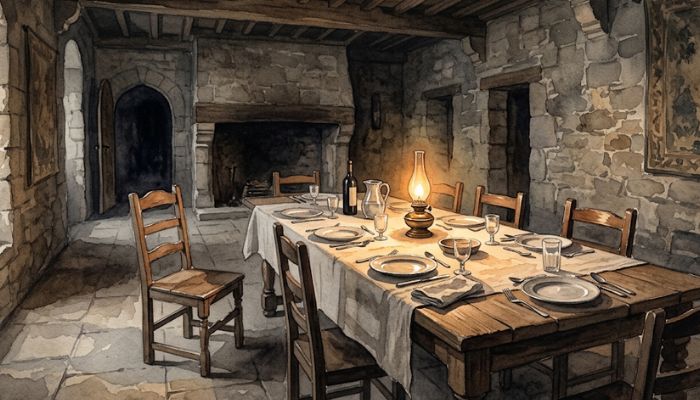
A man sits down to eat at the king's table, night after night, in the best house in Jerusalem. And the last thing the writer tells us about him is that his feet still do not work.
His name was Mephibosheth. Jonathan's son, which made him Saul's grandson, which made him a problem. When word came that Saul and Jonathan had died in the same battle, panic ran through the household, because new kings did not leave the old king's family alive.
"Jonathan son of Saul had a son who was lame in both feet. He was five years old when the news about Saul and Jonathan came from Jezreel. His nurse picked him up and fled, but as she hurried to leave, he fell and became disabled. His name was Mephibosheth." (2 Samuel 4:4)
He was five. He did not do this to himself. The woman who injured him was trying to save his life, running with a child in her arms while soldiers were on the road. She was frightened. She tripped.
And it never got better. He was five on the day he fell, and he is a grown man with a son of his own when we meet him again, and nothing about his feet has changed.
Some of you know that sentence from the inside. Something happened that you did not choose. Perhaps you were small. Perhaps the person who did the damage was running too.
Twenty years on, he is living in Lo Debar, out past the Jordan, at the edge of everything. Scholars argue over the name. The common reading is no pasture, though some render it simply nothing.
He is hiding. As the last male heir of Saul's line, being found means dying, so he picks the emptiest place on the map and stays. A man called Makir takes him in and feeds him. He hopes the palace has forgotten his name.
Hiding works. That is why people stay twenty years.
You may have built your own Lo Debar. You stopped answering the phone. You skipped the reunion dinner two years running, and by the third year they stopped asking, and you told yourself you were relieved.
Then David asks a question nobody required of him. A servant has the answer, and it comes out like this: "There is still a son of Jonathan; he is lame in both feet." (2 Samuel 9:3)
Twenty years on, and the first thing the king hears about the man is what is wrong with him.
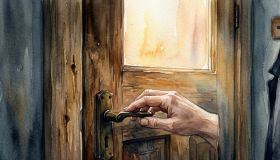
Soldiers arrive at the house where he has been hiding. They bring him to Jerusalem, and he goes face down on the throne room floor, certain he is about to die. Then the king says his name. Not the lame one. Mephibosheth.
"Don't be afraid," David said to him, "for I will surely show you kindness for the sake of your father Jonathan. I will restore to you all the land that belonged to your grandfather Saul, and you will always eat at my table." (2 Samuel 9:7)
He answers. "What is your servant, that you should notice a dead dog like me?" (2 Samuel 9:8) Dogs in that world scavenged rubbish at the edge of town, and a dead one was worth less than nothing.
David does not argue him out of it. He gives an order about the table.
"So Mephibosheth ate at David's table like one of the king's sons." (2 Samuel 9:11)
Same food as the princes, same seat every evening. And after the dead dog line he never speaks again in the chapter. He simply sits there, night after night, eating. You do not have to have anything to say to belong at that table.
Then the chapter closes.
"And Mephibosheth lived in Jerusalem, because he always ate at the king's table; he was lame in both feet." (2 Samuel 9:13)
Third time. The writer could have finished on the table and handed us a clean ending. He puts the lameness last instead, after all the good has already happened, because both things stayed true.
He is at the king's table. And he still cannot walk.
Nobody healed him. No verse has David laying hands on those feet.
So the table is not a promise that your condition will one day clear. Some of you will carry this for the rest of your life. Some of you will still be on medication in twenty years, managing rather than beating it, and you are tired of rooms where people imply otherwise. Scripture does not imply otherwise. It puts the lameness in the last line on purpose.
His feet never worked. What changed was where he ate and whether he had to keep out of sight, and that is most of a life.
None of it came to him because he earned it. The kindness arrived on the strength of a promise made between two other men before he was born. That is the shape of grace, and it runs straight to Christ. His is the name that gets us in.
You are brought to the table as you are, not as you will be once you are fixed. Come and eat.