The floor gives way twice.
You survived the first one. Nobody warns you that surviving is the trap. You survived it, and that taught your body a lie, that if you just held on through the worst there would be an after. So you held on. You went to the funeral. You signed the papers. You learned to say the sentence out loud without your voice going. You did the terrible arithmetic and paid what it cost, and somewhere under the grief a small animal part of you let its breath out, because the worst had come and you were still here to feel it.
Then the second thing came. It did not care that you were not ready. It walked through the door the first thing left open, found you already scraped down close to the bone, and took what was left.
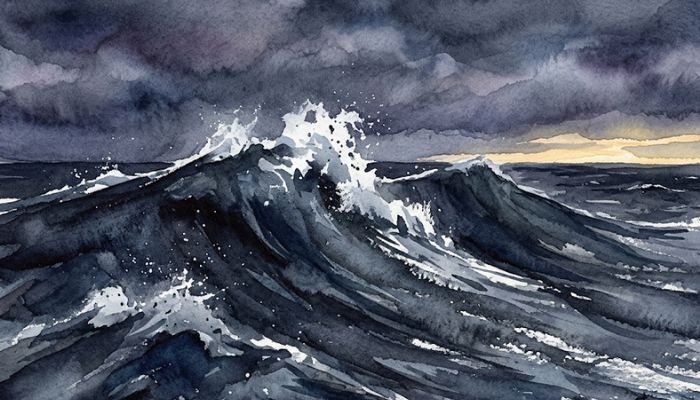
The psalmist knew this water. He was already parched, already asking his own soul why it lay so low in him, when he wrote it down: "Deep calls to deep in the roar of your waterfalls; all your waves and breakers have swept over me" (Psalm 42:7).
He does not say a wave. He says waves. Breakers. The roar of the falls, one deep crying out to the next as if the sorrow had a voice and was using it to call up more of itself. He is telling you exactly what it feels like when the losses stop taking turns.
Grief has a mercy built into it that most people never have to test. You are supposed to get one thing at a time. You bury it, you weep it, and the wound eventually thickens into a scar you can touch without flinching. That is what the sympathy cards assume.
Some of us are not given that. You lose the person, and before the ground has settled you lose the home that person made, and then the family that only ever gathered because they gathered it, so the one death keeps dying in every room they are no longer in. Or the health goes, and takes the work with it, and then the future the work was quietly building. Or you leave the church and find out too late that the church was also your friendships and your calendar and the words you used to pray with, so the leaving takes your language and you stand there mouthing something you no longer know how to mean.
One deep calls to another. And you, who saved every ounce of your strength for a single blow, find it ran out three waves back and the water is still climbing.
He does not pretend the sea is shallow. He keeps speaking while it closes over his head.
People struck only once do not always understand this, and I cannot blame them. They love you. They tell you that you have been through so much, and they mean it well, and they are picturing an amount. A sum you have finally finished paying, with rest on the other side of it. But you know it was never a sum. It was a tide. And a tide does not wait to see whether you healed from the last thing before it sends the next. It does not check. It comes in the dark, in the roar, whether or not you have anything left to meet it.
Then the psalmist does something I can hardly account for. He calls them "your waves." Your breakers. Mid-drowning, he turns and hands the whole flood back to God.
He could have blamed other owners. Cruel people. Rotten luck. A world that breaks its promises. All fair, and none of it would have cost him a thing. Instead he addresses the flood to the one he is somehow still talking to. He does not understand why the water is this deep. He is not being brave, and he is not resolved. He just refuses to let the flood carry off the last thing he owns, which is not answers or comfort or even hope yet. Only address. The bare fact of a voice still aimed at Someone.
That is what I want you to carry out of this psalm, if you can carry anything at all. The man is going under and still using his voice. And the next words out of him are not "and then the sea grew calm." They are an order he gives his own drowning soul: hope in God. He says it through his teeth. It does not take the first time, so he says it again in the next psalm, word for word, because some sentences have to be repeated, not because they are true yet but because you are trying with everything left to make them hold.
If the deeps are calling to each other in your life tonight, I will not insult you by calling the water shallow. It is not. I will not promise the next wave is the last, because I do not know that, and you have been lied to enough by people who needed your story to end sooner than it did. But I can tell you this. Someone went down into this same water, waves and breakers and the roar of it, and kept his voice the whole way down. The only reason we know his name is that the water was not, in the end, the last word over him.
You are still under it. You are also still speaking. Both are true right now, in the same breath, in the same dark. Do not let go of the second one. It is smaller than the flood and stronger than the flood, and it is yours.