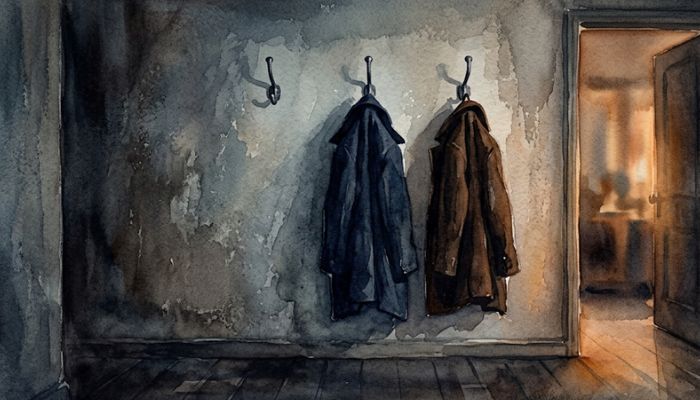
A man sat in his car in the driveway one February afternoon, engine off, hands still on the wheel. He had come from an hour with a counsellor who had explained something to him about his children, and he was trying to hold onto it before it slipped.
He did not go inside for a long time. Going inside meant the hallway, and the hallway meant the coat hooks. One of them had not held a coat in eleven months. He had thought about taking it down. He never did. Taking it down felt like agreeing with something.
When he finally sat at the kitchen table, he wrote what he could remember of the hour. At the top of the page he put a single sentence.
"They are not rejecting me. They are surviving."
His children were still gone that night. The texts were still cold. But something underneath the pain shifted, and it held for years.
You know the specific quality of that silence. It is not ordinary quiet. It has a shape, and the shape is a person deciding you were not worth it.
That is what withdrawal does to the mind. It hands you a verdict and lets you read it over and over, unsupervised, at two in the morning. You go back through everything looking for the moment you became a person someone could leave. And you find it. That is the cruelty. You always find it, because every parent has a bad year and every friend has a careless season, so the material is always lying there ready, and the finding feels like proof.
It isn't. It is what a mind does when it has no answer and needs one badly enough to build one out of scraps.
A person under sustained pressure will protect the relationship that feels most necessary to survive, even at the cost of one that matters just as much. Nobody sits down and decides to stop loving you. Something older than thinking does the sorting, below the level where reasons live. It releases what it judges it can afford to lose to keep hold of what it cannot.
This is what happens to a child in parental alienation. The child spends most of their hours with one parent. That parent's warmth cools when the child speaks kindly of the other, and returns when the child speaks against them. The child's attachment system reads the weather and concludes, correctly, that safety runs in one direction only. So it reroutes.
Consider what that costs a twelve-year-old. They had to reach inside and cut out a love they were born with, because keeping it made the house unsafe. They did not want to. They were not able to want to. They were a child in a position no child should be put in, and the only exit was to stop feeling something true about their own father.
So the coldness in their voice is not contempt. It is anaesthetic. When your son texts you something flat and it lands like a blade, you are hearing the numbness that had to be manufactured for him to keep living where he lives. He is not pretending. At the level of what he can feel, the love really is gone.
The hostility is not the real self. It is the cost of staying alive somewhere.
None of this is only a childhood story. The friend who went quiet when the family took sides. The adult daughter who found that loving you cost too much in the house she lives in now. Same mechanics underneath, every time.
Two parents can face the identical silence and become different people.
Bitterness is what happens when you accept a verdict that was never rendered. And I understand the pull of it, because bitterness at least gives you a role. If they judged you and found you wanting, then somebody was in charge, and a decision got made, and you are the defendant in a real case. Being a defendant is more bearable than being a bystander to something you could not stop.
But the defendant hardens. You rehearse your case to an empty room. You start reading every new relationship for signs of the next tribunal. After enough years the hardness stops being a posture. It becomes your face.
Grief is worse in the short run and better in the long one. It means you do not get the clean story: no villain you can hate properly, because the person who did the damage probably believes to this day that they were protecting someone. No ending either. You get to hold a child who cannot be held, indefinitely, with nothing coming back.
That is heavier. It is also the only posture that leaves you able to love someone who currently cannot love you back, which is the only useful thing available while you wait.
This is not a comfortable story told to get through the night. It is a more accurate reading of what is in front of you, and accuracy is what carries you through year eight.
David wrote in Psalm 27:10, "Though my father and mother forsake me, the LORD will receive me." Notice what the verse refuses to do. It does not soften the forsaking. It puts the worst abandonment a person can name flatly on the page and leaves it standing, unargued with. Then it sets something beneath it.
The forsaking is real. It is also not the floor.
You may not get your person back. That is the honest thing, and any promise otherwise would be cheap and you would smell it a mile off. But you do not have to carry a verdict that was never handed down. You do not have to be the defendant. You can be the one who knows what happened, and keeps knowing it, and leaves the coat hook where it is.