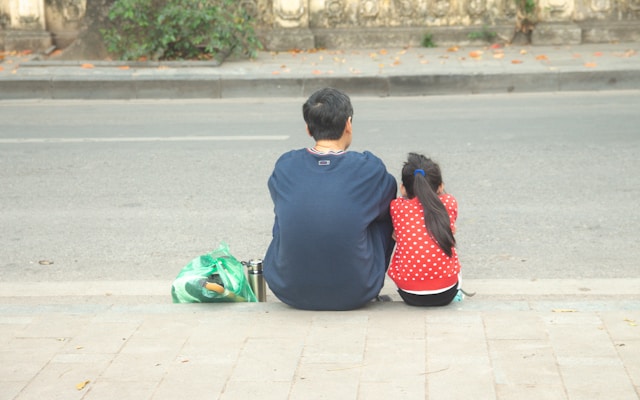
When the son finally turns for home, broke and rehearsing the speech he will give, the father sees him while he is still a long way off. You do not see someone at that distance unless you have been looking. The father has been watching the road, and not occasionally. Every day, for however long the son has been gone, he has been standing where he can see the horizon, hoping for a figure that did not come.
We do not know how long the son was away. The parable does not say. What it shows is a waiting that was costly and daily and completely unresolved, kept up by a man who refused to stop looking.
A particular kind of waiting belongs to the parent whose child has walked away. The phone does not ring. Sunday mornings carry a specific silence where someone used to sit. It is one of the loneliest griefs I know, and it does not resolve on any human schedule. Prayer does not hurry it. Faith does not will it closed. It has to be carried, day after day, on the road between hope and heartbreak.
The tears that belong to this waiting are the evidence of a love that has not given up. Love that keeps watching an empty road, that rehearses a reunion it is not sure will come, that gets up the next morning and looks again.
Jesus wept at the tomb of a friend before he did anything about it. "Jesus wept" (John 11:35) is what the honest expression of love looks like when it knows what the waiting has cost.
Your tears are what hope looks like when it has been carrying something heavy for a long time.
Then the father ran. "But while he was still a long way off, his father saw him and was filled with compassion for him; he ran to his son, threw his arms around him and kissed him" (Luke 15:20). Running was undignified for a man of his standing, and he did not care. He covered the distance the son could not cover on his own, and he did it before the speech, before the repentance had been completed, before any of the conditions the son had rehearsed on the road.
The road is long. The horizon may be empty today. The father is still at the window, and so are you.