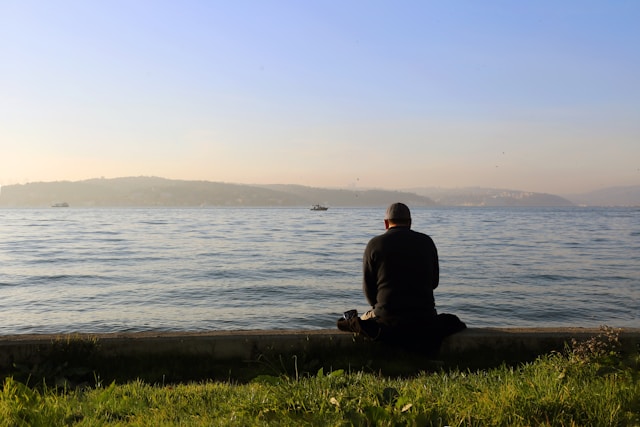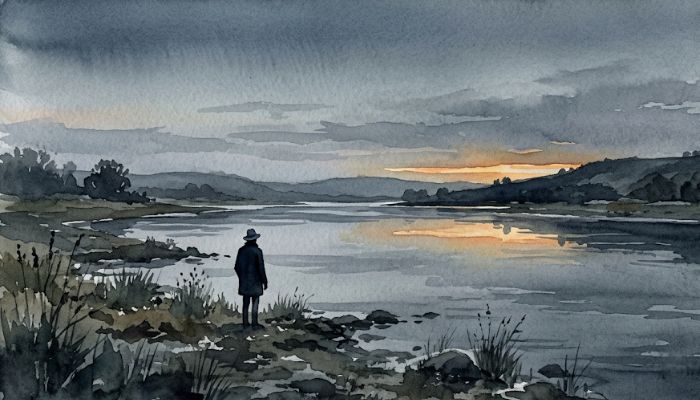
Jacob sent everyone across the river ahead of him. His wives, his children, his flocks, the whole life he had built over twenty hard years, all of it moved to the far bank while he stayed behind in the dark. He did not have to stay. He chose the empty side of the water, the way a man chooses the emptier room in a house that has gone quiet. Being alone on purpose hurts less than being alone by surprise.
That is where God met him. Not in the noise of the family. Not in the middle of his competence. On the bank, where he had run out of things to hide behind.
"So Jacob was left alone, and a man wrestled with him till daybreak. When the man saw that he could not overpower him, he touched the socket of Jacob's hip so that his hip was wrenched as he wrestled with the man." (Genesis 32:24-25)
He does not win the way he wanted to. He holds on, and the holding is what breaks him. God blesses him and injures him in the same grip. There is no version of the story where he gets one without the other.
The house is quiet now in a way you did not agree to. There is a chair that is still hers in your mind, even though she is not coming back to sit in it. You reach for the ordinary evening rhythms you built together and your hand closes on nothing. The nothing is loud.
You wanted the marriage. That is the part that shames you most. You would have stayed. You did stay. You kept reaching for the covenant while it was being pulled out of your hands.
You have counselled other men through this. You know all the right words. And the words are ash in your mouth now, because knowing them never made you able to keep her.
So you cross to the empty bank. At least there you do not have to perform being fine. And that is exactly where the wrestling starts.
When the sun came up, Jacob had a new name and a ruined hip.
"The sun rose above him as he passed Peniel, and he was limping because of his hip." (Genesis 32:31)
The limp stayed. Scripture will not let us pretend otherwise. He met God face to face and lived, and he walked away marked for the rest of his life. A catch in his step that would show up at the worst moments, without warning, long after the night itself had faded.
You carry your own version. It surfaces at a wedding, when the vows are read and something in your chest goes tight and cold. It surfaces at a hospital bedside, when you are meant to be the steady one. It surfaces in the middle of a sermon on faithfulness. You hear your own voice saying the word, and you feel like a liar, though you are not one. You were the faithful one. That is somehow the crueller joke.
The fear underneath every other fear is the one you can barely say. That a limping man cannot lead. That the wound has quietly disqualified you, and everyone can see it but no one will tell you.
You know all the right words. And the words are ash in your mouth, because knowing them never made you able to keep her.
For years you may have preached grace the way a man describes a limp he has only read about. Accurate. Kind. Offered from the outside, where it costs nothing.
Then it becomes your own hip. And you discover that the grace you offered so smoothly was thinner than you knew, because you had never once had to put your whole weight on it. Now you have no choice. There is no crossing the room without leaning, and the leaning teaches you what all your fluent sermons never could.
Here is what the ruin hands you. The wound does not end the ministry. It moves it. You come down off the platform where you pointed at rescue from a safe height, and you stand in the mud with the ones who are also limping. You point to the One who met you at the river and would not let go until He had blessed you and broken you in the same hold.
People know the difference. They can hear when a man is describing water he has only seen from the road, and when he is describing water he drank while he was dying of thirst. The people who once admired how clearly you spoke will come to trust how badly you have been hurt. That trust goes down into rooms that clarity never reaches.
Jacob limped into the rest of his life. He fathered a nation. He blessed his sons with his last breath. He did all of it uneven, favouring the hip. Nowhere does the story treat the limp as a subtraction. It was how you knew him. It was the evidence, written into his body, that he had gripped God in the dark and had not been let go.
Some mornings you will still feel the emptiness of the far bank before you feel anything else. The limp will still find you at the worst moment. But the One who wounded you in the holding is the One who is holding you still. He did not cross back over the river and leave you there. He walked out of that night beside you, matching your uneven step, and He has been walking at that pace ever since.
The same story became a song. If the words above found something in you, sit with them a while longer here.