You have been looking for a while now.
At the clinic door, in case the doctor comes out with a different face this time. At your phone on the kitchen table, screen down, which you turn over every few minutes anyway. At the ceiling at three in the morning, which has nothing on it and gets looked at all the same. Looking has become a habit of the body, the way a person keeps checking for a message long after they have stopped expecting one.
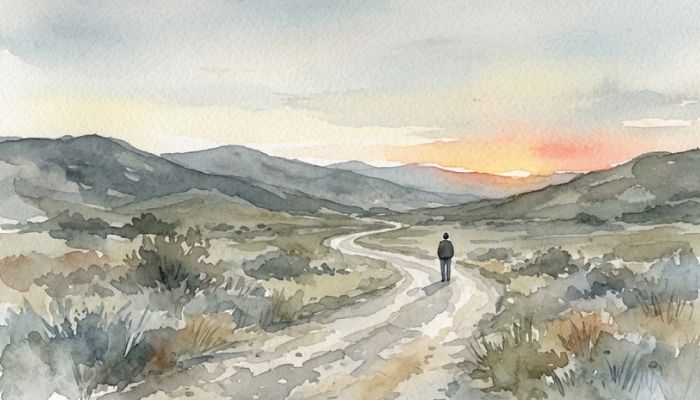
The pilgrim in Psalm 121 is doing the same thing on a dirt road, with dust in his sandals and the sun on the back of his neck, and the road is climbing toward hills.
"I lift up my eyes to the mountains— where does my help come from? My help comes from the Lord, the Maker of heaven and earth." (Psalm 121:1-2)
Most of us read the first line as if it were already the second. As if lifting your eyes to the hills were the same thing as trusting God. But the hills offered this man no comfort. Robbers waited in the rocks above the road. And up on the ridgelines stood the old shrines, stone altars and carved poles under the trees, the "high places" where Israel had gone for generations to beg other gods for rain and children and safety. Jeremiah names how that ended: "Surely the idolatrous commotion on the hills and mountains is a delusion; surely in the Lord our God is the salvation of Israel." (Jeremiah 3:23)
People had climbed those hills carrying grain and goats. They had come back down with their hands empty.
So the pilgrim lifts his eyes with a whole history of failed hills above him, and he asks. Where does my help come from? He does not know. He says so out loud, on the road, where anyone walking with him can hear. And the question is allowed to stand.
You may have been taught to hurry past that question. To get to the second verse quickly, because lingering on the first sounds like doubt, and doubt sounds like failure. But the psalmist wrote the question down. The editors of the Psalter kept it. People have sung it for three thousand years with the question left in.
The psalm gives you one full line of looking and not knowing before a single word of assurance arrives. You are allowed to stay on that line longer than a breath.
You have your own hills. The friend who texted every day for a month, then every week, then stopped. The medication that worked until the week it did not, and the appointment where the doctor said "we can try something else" in the tone people use for a fourth attempt. The church where the pastor shook your hand at the door and did not know your name. The version of yourself who was going to be stronger by now. You climbed each one. You brought what you had. You came back down.
A person still scanning the horizon has not given up. They are still waiting to be helped.
Scanning the horizon does not make you faithless. It makes you a person who has not yet been helped, and who has not stopped wanting to be. And wanting is what keeps a person walking.
The answer does not point at a hill.
It does not say the help is coming from the north road, or from the temple, or from the person you have been watching for. It reaches past every ridge you can see. "The Maker of heaven and earth." The hills belong to the one who is answering. Every altar where people once begged for help sits on ground he made.
Your help, then, does not have to arrive by the route you were watching. It may come through the night nurse who pulls a chair up instead of standing at the foot of the bed. It may come through a Tuesday that is slightly lighter than Monday, for no reason you can name. You were watching the north road, and it came in through the back door.
The voice changes after the second verse. Verses one and two are spoken by the pilgrim. I lift up my eyes. My help comes. From verse three on, the psalm turns and speaks to him: "He will not let your foot slip— he who watches over you will not slumber; indeed, he who watches over Israel will neither slumber nor sleep." (Psalm 121:3-4)
Someone else is saying this. The traveller walking beside him, or a priest at the gate when he finally arrives, or the whole crowd on the road singing the answer back. The pilgrim asked the question alone. He did not have to answer it alone.
That is the kindest thing in the psalm for a person who has been looking a long time. You do not have to talk yourself from the question to the answer. On the days you cannot, someone else can say the second half over you. A friend who sits on the end of the bed and reads Psalm 121 out loud while you look at the wall. A chaplain who reads it in a ward at four in the afternoon. A congregation you are barely holding on to, singing it while you stand at the back with your mouth shut. The psalm was built for that. It has room in it for the person who can only manage the question.
The word "watch" runs through the rest of the psalm six times. Watches over you. Watches over Israel. Watches over your life. Watches over your coming and going. While you keep watch on the hills, someone is keeping watch on you. The watching runs both ways, and only one of you gets tired.
While you keep watch on the hills, someone is keeping watch on you.
You can keep looking up. You can keep asking the question, as many times as you need to. The psalm will not correct you for asking. It asked first.
And past the last hill you can see, the one who made the hills has not lost sight of you.
You lifted your eyes today. That was not nothing.