In the fifty-first minute, Canada was taking Qatar apart. Vancouver was roaring, the score already lopsided, and Ismaël Koné was at the heart of it, the engine in midfield, having the tournament of his life.
Then a tackle came in from behind, and his leg broke.
You could see the moment it happened. The disbelief on his face. His teammates waving frantically to the bench, then closing a ring around him so the cameras could not feed on his pain. He was lifted onto a stretcher and carried off, waving to the crowd as he went, an oxygen line at his face. In a single second a man at the centre of everything became a man watching from a medical room while his team played on without him. Canada won 6-0, the biggest win in their history, and he experienced the best day his country had ever known from a hospital bed, waiting for surgery.
If you have ever been the one who suddenly could not carry the load, you felt that in your own bones.
Maybe it was burnout that finally pulled you down, or an illness, or a mind that simply stopped cooperating one ordinary morning. One day you were the engine. The next you were on the stretcher, watching the people who depend on you carry on, and the worst of it was not the pain. It was the fear underneath the pain. The fear that if you cannot produce, you lose your place. That your value was only ever your usefulness, and now that it is gone, so are you.
You were carried off the pitch. You were not carried out of the story.
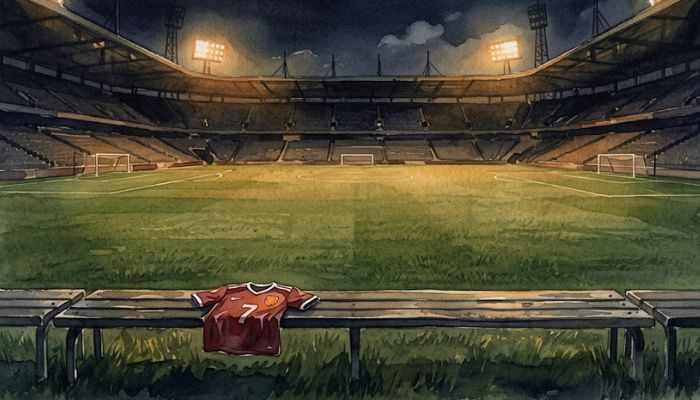
Here is what the injury exposed, though. Koné's worth to that team did not break when his leg did. Later in the match a teammate scored and ran to the sideline holding up Koné's jersey, number eight, lifting it to the crowd. Not because of what Koné could do that day. Because of who he was to them.
You are a fragile human being, and you were never built to run without breaking. The most faithful thing you can do when your capacity gives out is not to crawl back onto the field and play hurt to prove you still matter. It is to let yourself be injured. To stop demanding output from a body and a mind that have nothing left to give. God has never priced your place in his kingdom by your production, and the people who truly love you are already holding up your jersey while you cannot stand.
You do not have to earn your way back into the story. You are still in it, on the bench, healing.
That is not the end of anything. Koné will play again. So, in time, will you. Though the game you return to may not be the one you left, and the player you come back as may be someone the injury made, not the one it took. The field is still yours.