Pentecost is remembered for the loud miracle.
Tongues of fire. A sound like a violent wind. Crowds from every nation hearing the gospel in their own language, and the Spirit poured out with such force that bystanders assumed the disciples were drunk at nine in the morning. "All of them were filled with the Holy Spirit and began to speak in other tongues as the Spirit enabled them" (Acts 2:4). The church has preached that story as its birthday ever since, and rightly.
A second language miracle of the same Spirit almost never gets mentioned, and it is the one most of us need more.
The first Pentecost gave the disciples words. The second one is for the days when you have none left. "In the same way, the Spirit helps us in our weakness. We do not know what we ought to pray for, but the Spirit himself intercedes for us through wordless groans" (Romans 8:26).
The same Spirit who filled the disciples with foreign tongues also intercedes through groans that cannot become language. The Greek behind "wordless" is alalētois, inexpressible. The Spirit prays a prayer that by its nature cannot be put into words, on behalf of believers who cannot put their need into words either.
If you have been in a long hard season, you know what it is to lose your vocabulary.
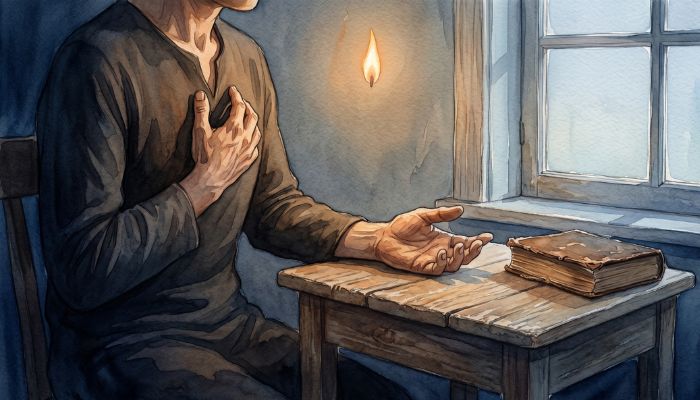
You sit in the chair you used to pray in. You open your mouth and nothing comes. The well-formed sentences you used to produce are not available. You feel that you should be praying, that the situation requires it, and you cannot manufacture it. The exhaustion has gone deeper than your language. Your body is doing one thing, producing a heavy sigh somewhere between chest and throat that does not resolve into a word.
The Christian instinct here is to feel you have failed at prayer. You have not. The sigh is the prayer.
Romans 8 names exactly what is happening in your body when no words come, and calls it intercession. Four verses earlier Paul uses the same root for the whole of creation, which "has been groaning as in the pains of childbirth right up to the present time" (Romans 8:22). Your sigh joins a sound creation has been making since the fall, and the Spirit is in it.
The same Spirit who descended on the disciples in tongues of fire descends on the depleted believer at 3 a.m. He is not less present in the silence than in the noise. If anything he is more present, because depletion has made room for him to do what fluency will not let him do.
The first Pentecost gave the church its words. The quiet Pentecost gives the exhausted believer permission to have none.
You do not have to speak fluently to be heard.
The God who was unintimidated by the languages of every nation at Pentecost, whose Spirit met Parthians and Medes and Elamites each in their own tongue, is more than capable of receiving your sigh. He is not waiting for a properly worded prayer before he accepts what you are offering. By his Spirit he is already receiving it, and the translation is happening beneath your vocabulary, so the prayer arrives in heaven in a form more accurate than anything you could have crafted.
The 3 a.m. sigh is prayer, and you do not need to follow it with anything. Lord is enough. The breath you let out, half-resigned and half-asking, is the Spirit interceding for what you do not know how to ask for.
The exhausted silence in the chair is prayer. No words coming does not disqualify the sitting. The Spirit is praying through your inability, and you are giving him space to do what he came to do.
The wordless lament for the friend you cannot help, the situation you cannot fix, the future you cannot see, held in your body without articulation, is being translated as you hold it. You are not abandoned by prayer in your speechlessness. You are inside a prayer the Spirit is praying on your behalf.
Pentecost in the loud sense was a gift to the church for the work of proclamation. The quiet Pentecost is a gift for the work of survival. Both are real, both come from the same Spirit, and both are still happening.
If you cannot find the words this morning, the Spirit who poured himself out at Pentecost is doing the praying. The sigh is enough.