David reaches for the worst desertion he can picture: "Though my father and mother forsake me, the Lord will receive me" (Psalm 27:10). Even if the two people who were never supposed to leave did, he says, God would still take him in. That is the floor he is standing on, and it holds.
And then he says a strange thing. Not a word about heaven. Not a promise that it will all make sense on the other side. He plants his flag in the one place none of us would choose:
"I remain confident of this: I will see the goodness of the Lord in the land of the living" (Psalm 27:13).
The land of the living. Here. This ground, the one soaked with everything you are trying to survive.
When the pain runs long, heaven becomes the easy place to file our hope. You catch yourself doing it in small ways. Maybe it will make sense one day. Maybe the reunion, the healing, the answer, all of it is being kept somewhere safe and far off, past the edge of this life where nothing hurts. There is real comfort in that, and I would not take it from anyone. But look at where David refuses to put it. He does not say he will see God's goodness in the sweet by-and-by. He says he will see it in the land of the living, the same ground where the people we counted on can walk out the door.
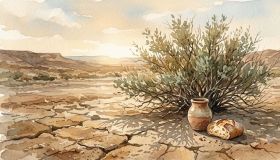
The land of the living is not a gentle phrase once you stay with it a while. This is the country of unanswered scans and unreturned calls, of the chair at the table nobody fills anymore. It is where the abandonment happened. The agony still lives here, in the body, in the house, in the ordinary Tuesday you have to get through anyway.
That is exactly where David expects to see goodness. Not once the pain is over. In the thick of it.
He does not point to heaven. He plants his hope in the ground that is breaking his heart.
This is a harder hope than the one we usually settle for, and a better one. The someday-hope costs us nothing today. It lets us close our eyes and wait it out. David keeps his eyes open. He looks around at a life that has genuinely come apart and says the goodness of God is somewhere in this frame. He has not seen it yet. That is what makes it confidence and not sight. He is standing in the wreckage, saying the God who receives the forsaken has not backed away from the wreckage, and neither has His goodness.
So the work is not to escape the land of the living. The work is to see what is already in it.
The goodness David is confident about rarely announces itself. It stays low to the ground. A meal a friend leaves off without knocking. The strength that arrives from somewhere you did not manufacture, enough to get you upright and through the afternoon. The stubborn fact that you are still here, still breathing, on a day when giving up would have been simpler.
None of that undoes the leaving. The people who forsook you have still forsaken you. The land is still hard. But God did not save His goodness for a cleaner country. He put it here, in this one, with you, where the hurt is.
You do not have to wait for heaven to be received. You are in the land of the living, and so is He, and so is His goodness, lower to the ground than you have been looking.