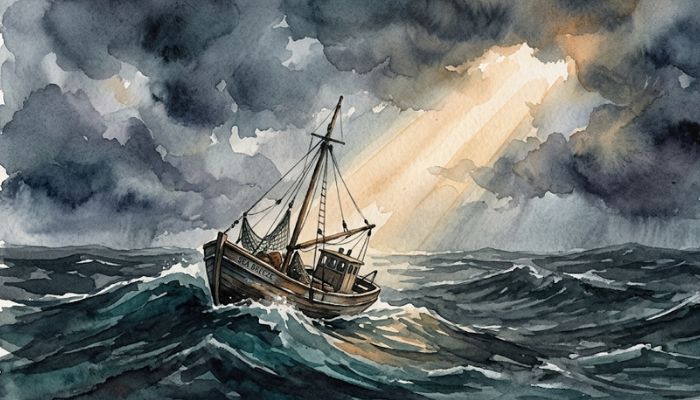
You know the kind of storm that does not announce itself. The day was ordinary. The water was calm enough at dusk. Then the wind turned, and now you are bailing with both hands while the boat takes on more than you can throw out, and the One who could help seems to be sleeping through the worst of it.
Mark tells it plainly. The disciples had pushed off across the lake in the evening, and a squall came down so hard the waves were breaking over the boat. Jesus was in the stern, asleep on a cushion. They woke him with the only prayer panic knows how to pray:
"Teacher, don't you care if we drown?" (Mark 4:38)
That is the question under most of our storms. Not "will I survive this," but "does he even notice."
Rembrandt painted this scene once, the only seascape he ever made. A boat pitched up the face of a wave, the sail half shredded, men hauling on ropes that will not hold. Count the figures and you find a quiet surprise. Most people expect thirteen, Jesus and the Twelve. The painting holds fourteen. Art historians have long believed the extra man, the one gripping a rope with one hand and clutching his cap with the other, looking straight out at you while the sea tries to take him, is Rembrandt himself. He painted his own face into the boat.

Here is what gives that small choice its weight. When Rembrandt painted himself into that boat in 1633, the worst of his life had not yet come.
He did not know that. He was young, newly successful, about to marry a woman he loved. Then the years did to him what years do. His wife Saskia gave him four children. Three died as infants, one after another, each small coffin a wave he had not seen coming. Saskia herself was gone by thirty, dead the same year he finished his most famous painting. He buried her, and for nearly a decade he could barely bring himself to lift his oils. Later the money went too, then the house, then almost everything. The grief kept arriving in sets, the way it does, one swell behind the last.
The man who reached for that rope in the painting was reaching for something he would need for real. He put his frightened face in a boat that did not sink, years before he learned how much he would need a boat that does not sink.
Maybe that is the truest thing the painting says to you. The boat held before he understood why he would need it to.
You may be in a season like that. Not the loud, single crisis, but the kind that keeps coming, where you bury one grief and another is already cresting. You bail and bail and the water keeps finding its way back in. And somewhere underneath it all sits Rembrandt's question, and the disciples' question, and yours: does he see this, or am I alone out here.
What the storm wants you to believe is that it defines everything. The noise of it. The size of the next wave. The fact that the water is rising and nobody is coming. When you are inside it, the storm feels like the only true thing in the world.
But the boat is not defined by the water. It is defined by who is in it.
Christ was asleep in the stern, and to twelve experienced fishermen his sleeping looked exactly like indifference. They had decided his quiet meant he did not care. They were wrong about that. His silence is not the same as his absence, and his stillness is not the same as not caring. He was in the same boat, taking the same cold spray, rocked by the same chaos, nearer to the danger than any voice calling helpful instructions from the beach could ever be.
This is the strange mercy of the whole gospel. God does not save you from a safe distance. He climbs into the boat, into the very weather of your grief, and stays.
Then he stood and spoke to the wind, and the water went flat as glass. In the sudden ringing quiet he turned to them and asked a question that has outlived everyone who first heard it:
"Why are you so afraid? Do you still have no faith?" (Mark 4:40)
Hear it gently, because it was not meant to shame. It was the question of someone who loves you and wants to know where you have been putting your trust. In your own grip on the rigging. In whether the water ever calms. In your ability to outlast the wind by sheer endurance.
He is not promising you a life without storms. He never did. Rembrandt's life was proof enough of that, and so, probably, is yours. He is asking you to believe that no storm gets the last word while he is in the boat with you.
The wind has not dropped yet. You are still bailing tonight, and the next swell may already be rising in the dark. But you are not the only one in this boat, and you never were. The fourteenth man reached for a rope in a vessel that did not go down, and he turned his face toward yours so you would know where to look.