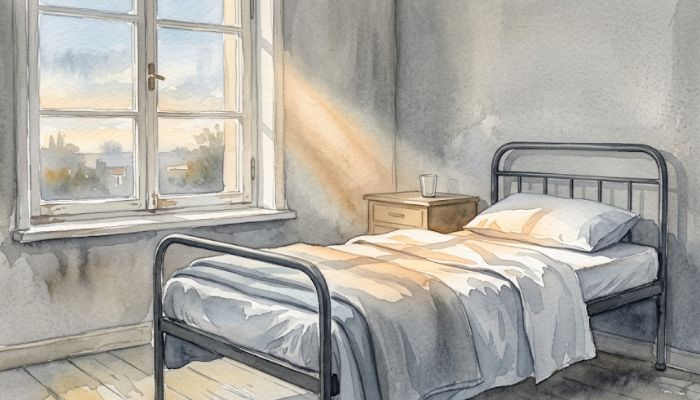
Every photograph in the newspaper carries a line of print beneath it. Without that line the same picture means two opposite things: a man on his knees is praying, or a man on his knees is collapsing. The words underneath decide which.
People read you the same way, and they write the line without showing you.
You learn this quickly once you have been unwell for a while. You stop coming to church, and someone writes drifting. Three weeks pass without a reply, and someone writes rude. None of them watched the hour it took you to get dressed that morning.
The captions that sting come from the people who were there at the start. They brought food in the first month and sat with you while it was still a crisis. Somewhere in the second year they settled on what you are, and the visits thinned out soon after. You stopped being someone they worry about and became a situation they hold a view on.
You can try to correct it. Most people try once. You explain the illness and watch the explanation filed as an excuse. You defend yourself and get read as defensive. Arguing with a caption usually thickens the ink.
An old man wrote a psalm about being read, and about fearing what the readers would decide.
"I have become a sign to many; you are my strong refuge." (Psalm 71:7)
The word behind "sign" is mopet. God used it for the wonders in Egypt, and for Ezekiel, whom he made pack his bags in the street in daylight so that the city would stop and ask what it meant. A mopet is a person God sets in public so that people look and draw conclusions. Nobody volunteers for it, and the sign has no say in what they conclude.
Scholars still cannot settle which caption belongs under this man. Some read the word as a wonder: look how God has carried him for seventy years. Others read it as an omen: look what God has allowed to happen to him. Same man, same failing body, opposite verdicts.
He knows what the readers are weighing, and he asks for the one thing he cannot secure for himself.
"Do not cast me away when I am old; do not forsake me when my strength is gone." (Psalm 71:9)
He can live with being old. What he cannot face is losing his place once the usefulness runs out, and he can see it coming. The visits get shorter. The phone rings less. He will be set aside at the exact moment he can no longer stop it.
Underneath that fear sits a worse suspicion: that the love was always measured against what he could carry, and he is only finding that out now that the carrying has stopped. Anyone whose illness has outlasted other people's patience has met that suspicion at two in the morning.
He does not argue with the readers. He does not campaign for the kinder caption. He tells you where he is standing while they read him, and he keeps talking.
"My mouth is filled with your praise, declaring your splendour all day long." (Psalm 71:8)
He has lost his strength and kept his voice. A day and a tongue are all he has left, and he spends both on God.
Whatever the neighbours write under him, he has already written his own caption.
The old man asks not to be cast away, and the neighbours cannot answer that. They will read him whichever way suits them. So God gave the world something else to read. His Son hung outside Jerusalem where every passer-by could see, unable to move his own hands, needing a sponge on a stick to get a drink. The crowd looked at him and wrote him off. Then he prayed the old man's prayer.
"My God, my God, why have you forsaken me?" (Matthew 27:46)
The answer came back no, so that the same prayer out of your mouth could be answered yes.
"Never will I leave you; never will I forsake you." (Hebrews 13:5)
People will go on reading you, and some of them will get it wrong for years. That is a real loss, and no verse deletes it. What the wrong captions cannot touch is whether you are kept.
A woman in a hospital ward fell asleep before she could pull her blanket up, and woke at three in the morning covered. She never learned whose hands did it. She only knew that someone had come in the dark and judged her worth covering. You are being kept like that, read wrongly by half the street and held anyway.