On the days you cannot get out of bed, the shame arrives before you do.
You lie there and the accusations start. Other people are up. Other people are working. Other people are managing their lives while you cannot manage the short distance between the mattress and the floor. You have become, in your own estimation, a broken tool. Useless to your family, useless to your work, useless to the people who used to count on you. The world rewards output, you have none to give, and so you have quietly concluded that you are worth nothing.
David, hunted and exhausted, prays a small line in Psalm 17 that goes straight at this. "Keep me as the apple of your eye; hide me in the shadow of your wings" (Psalm 17:8).
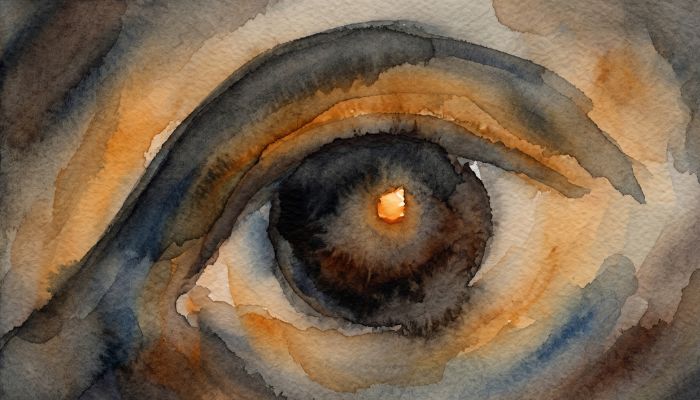
The phrase has worn smooth with use, so that it now just means someone cherished. The Hebrew is stranger. Ishon bat ayin, the little man of the daughter of the eye. Ishon is a diminutive, and it names the pupil after the tiny reflected figure you can see in someone's eye when you look closely enough. The image already contains the idea of being held in another person's gaze.
David is not asking to be kept like a fortress. He is not asking to be made strong or armoured or self-sufficient. He is asking to be kept like the pupil of an eye. The most delicate part, which cannot bear even a speck of dust without flooding with tears.
The pupil cannot lift anything. It does the body no manual work, bears no weight, holds up no structure. By every measure of utility it is useless. It only receives light. It produces nothing the rest of the body could lean on.
And it is the single most fiercely protected part of you.
When anything comes near your eye, your whole body moves to defend it before you have decided anything. The eyelid slams shut. The head jerks back. The hands fly up. The entire system mobilises, instantly and involuntarily, to guard the one part of you that can do no work at all. You do not protect the pupil because it is strong or useful. You protect it because it is precious and because it cannot defend itself, and in the body those two things go together.
This is the image David reaches for to describe how God holds him. God does not guard you because you are useful. He guards you the way the body guards the eye: instantly, fiercely, precisely because you are fragile.
The pupil produces nothing and is valued above almost everything.
Your crushed, non-functioning state is not a liability God is tolerating until your usefulness returns. The quiet belief that you are worth what you produce does not survive this verse.
If you have been measuring your worth by your output, put the measuring stick down.
The output was never the thing. On the day you ran the whole household and met every deadline and held everyone up, you were the apple of his eye. On the day you cannot lift your head from the pillow, you are exactly as much the apple of his eye. The value did not move, because it was never attached to what you could do. It was attached to who you are to him, and that does not fluctuate with your capacity.
The reflex that guards the eye is involuntary. The body does not decide, case by case, whether the eye has earned protection today. It protects, always, automatically, because the eye is the eye. God keeps you more like that reflex than like a transaction. He is not weighing your usefulness this morning before deciding how much to care.
You feel worthless because you cannot work. He looks at the same flattened, exhausted, non-functioning person and sees the pupil of his eye.
You are not a broken tool. You are kept and guarded precisely in the place where you feel most fragile, and that is exactly where the protection is fiercest.