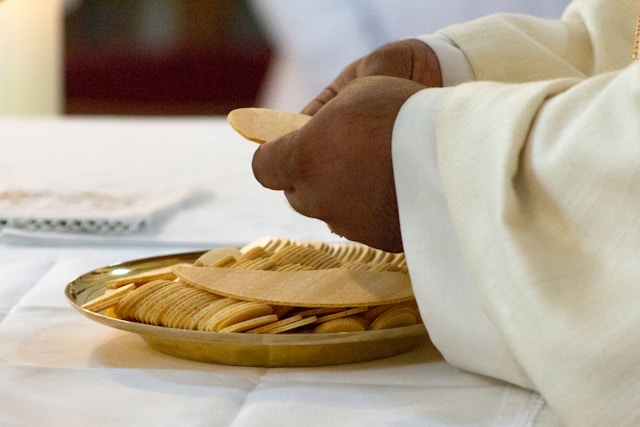
Henri Nouwen spent the last years of his life on four words. In "Life of the Beloved" he noticed that the gospel writers describe the bread at the Last Supper with four verbs. Jesus took it, blessed it, broke it, gave it. The same four words, Nouwen believed, are spoken over us.
I find this comforting and difficult in roughly equal measure. Comforting, because it means our lives have a shape and the shape is not random. Difficult, because three of the four are not words we would have chosen.
The Greek is labōn. The bread lifted off the table, set apart for something.
You were taken before you knew it. Before you had done anything to earn it or disqualify yourself from it, you were lifted into being and held. "Before I formed you in the womb I knew you, before you were born I set you apart" (Jeremiah 1:5). The taking is the original word over your life. You did not begin as a problem to be solved. You began as someone chosen, picked up, held in the hands of God before you were aware of having a self at all.
Most of us live without remembering this. We assemble our worth day by day out of usefulness and approval, as though it were ours to build. The taking was first, and the taking was free.
Then the bread is blessed. "While they were eating, Jesus took bread, and when he had given thanks, he broke it and gave it to his disciples" (Matthew 26:26). The word behind "gave thanks" is eulogēsas, to speak well over something.
Our culture is starving for this. To be blessed is to have someone of weight speak well over you and mean it. Not flattery, but a word that names you as good. "This is my Son, whom I love; with him I am well pleased" (Matthew 3:17). The Father said this over Jesus at the Jordan, before the miracles and before the cross. The blessing came first.
The blessing comes first over you too. Before the resume, before the failures you cannot stop replaying at 2 a.m. The voice that matters most has already spoken, and what it said over you is beloved.
If you cannot feel this, you are not unusual. Most of us feel it only sometimes. The work of the Christian life is largely the slow work of letting that word land deeper in the body than the older words that got there first.
And then the bread is broken.
No honest version of the Christian story leaves the bread whole. The breaking is not punishment, and it does not mean something has gone wrong. It is, in a way none of us would have chosen, part of how the bread becomes useful.
You have been broken in your own particular way. The marriage. The diagnosis. The child who walked. The vocation that did not come. The church that wounded you. The body that no longer cooperates. The breaking is not the same for any two of us. The fact of it is.
Nouwen's question is not whether we will be broken, since we will be. His question is what we do with it. Whether we let it close us, or let it slowly open us toward other people.
The bread that is not broken stays whole and small. The bread that is broken can feed.
And finally, only finally, the bread is given.
The self-help version of a life cannot account for this. We are told the goal is to be whole and fulfilled. The gospel says the goal is to be given.
Given to your spouse. Given to the people God has put on the small piece of ground that is your actual life. Given through hospitality and patience, through the slow steady showing up that nobody applauds. Given through the wounds you no longer try to hide, because hiding them costs more than naming them ever will.
The giving happens through the breaking rather than despite it. The places where you have been broken are, slowly, the places where Christ becomes visible in you to other people. The cracked places rather than the polished ones.
You may not feel given today. You may feel only taken, or blessed and then forgotten, or broken with no apparent purpose. That is allowed. The four words do not land in tidy sequence in any one season, and sometimes you sit in the broken a long while before the given becomes visible.
The shape is real. The hands holding the bread are real. The Lord who broke himself first is the one holding you.
You are taken. You are blessed. You are, in your particular way, broken. And you will, in time, be given, in ways you may not yet see, to people who do not yet know they need what your breaking has made you able to bring.
The road is long. You are not walking it alone.