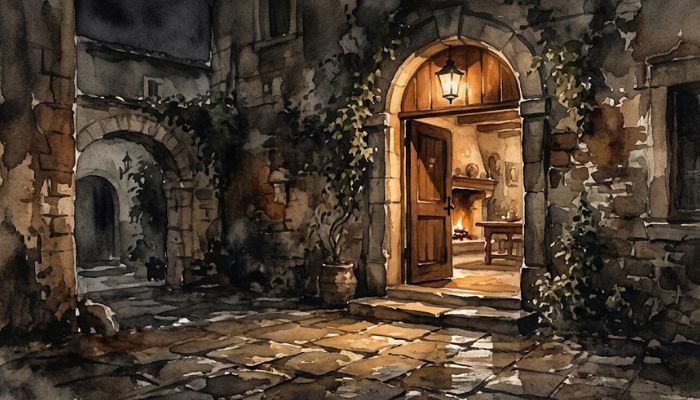
Shame is quieter than guilt. Guilt tells you that you did something bad. Shame tells you that you are the bad thing, and it does not argue the point. It sits with you while you get on with the day.
His name is Mephibosheth. Inside it sits the Hebrew word bosheth, which means shame. The name reads as God scatters shame.
The shame goes. Mephibosheth stays.
His grandfather was King Saul, which made him dangerous to the new regime. When Saul and Jonathan died in battle on the same day, his nurse picked him up and ran, and she fell, and he was five years old, and his feet never worked again. He grew up out past the Jordan in a town called Lo Debar, carried from room to room, fed by other people. Twenty years of that, and every time somebody wanted him they said the shame word out loud.
Then a servant told the king he was alive. "There is still a son of Jonathan; he is lame in both feet." (2 Samuel 9:3)
Not his name. His defect.
Shame leads with the thing you would least like mentioned, and it never waits to be asked.
The soldiers carried him to Jerusalem and he went face down on the throne room floor, certain this was the day the house of Saul ended. The king spoke first.
"David said, 'Mephibosheth!' (2 Samuel 9:6)
He used the name. He did not soften it. He said the shame word, and then gave the man a son's place at his table.
He returned the land too. The seat was the costly part, a place at the king's own table for the rest of the man's life.
A seat at a king's table was a legal standing. It says you have a place.
"So Mephibosheth ate at David's table like one of the king's sons." (2 Samuel 9:11)
He has to be carried in. Somebody lifts him into that seat in front of the princes, every evening, for the rest of his life. The feet Ziba mentioned first are on display at every meal, and the place is laid at every meal, and neither fact cancels the other. He is a man at dinner.
The oldest instinct in Scripture is to get out of sight. When everything goes wrong in the garden, the first man does not apologise. He hides. "I heard you in the garden, and I was afraid because I was naked; so I hid." (Genesis 3:10)
Every Lo Debar since has been built from that sentence. Shame needs distance to stay alive. It runs on one assumption, that if the whole thing were known, the room would empty.
Which is why argument does not touch it. You can talk yourself into your own worth on a good morning and lose the ground by lunchtime. Shame is a posture, learned early and held in the body.
What takes it apart is being fully known and kept anyway.
David had Ziba's report before he set eyes on the man. Nothing surfaced at that table that the king had not already been told, so nothing was left to guard.
That is the scattering. The worst of it goes on the record, and the seat is laid anyway, and it is laid again the following evening.
The shame stayed in Lo Debar. He ate in Jerusalem.
It takes years. Mephibosheth hears the offer and answers, "What is your servant, that you should notice a dead dog like me?" (2 Samuel 9:8) David lets the sentence stand and gives an order about the seating instead. Grace does not switch off the verdict on contact.
He never speaks again in the story. He eats, at the place laid for him under the name that meant shame.
That is how shame loosens, when it loosens. Through being fed, in the same seat, by someone who kept setting it.
And the name turns out to be a promise. "Who for the joy set before him endured the cross, scorning its shame, and sat down at the right hand of the throne of God." (Hebrews 12:2) Christ took the shame and sat down, and because he sat down there is a place laid for people who still call themselves dead dogs.
Nobody will ask you to prove you have stopped believing the worst about yourself. You may believe it for years yet.
Come as the one who believes it. Sit down anyway. He scatters shame.