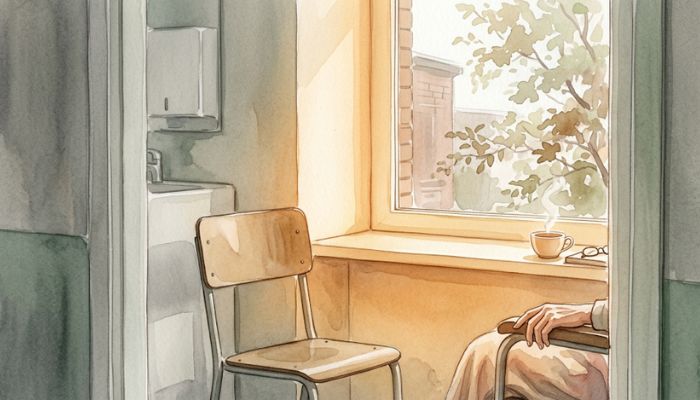
People sometimes ask me what a chaplain in a mental health setting actually does.
It is a fair question, because the honest answer surprises them. They imagine a chaplain arrives with comfort, says the right verse, prays the right prayer, and leaves the room a little brighter than they found it. They imagine a fixer in a clerical collar. What a chaplain in a rehabilitation setting actually learns to do, often slowly and against every instinct, is much quieter than that. It is to stop trying to fix anything at all.
A mental health rehabilitation centre is a place where linear healing is rare. People do not arrive broken and leave whole in a tidy arc. They cycle. They plateau. They relapse and recover and relapse again. The ordinary pastoral instinct, the one trained into most of us, is to move a suffering person toward resolution. In this environment, that instinct fails almost immediately. The residents are not in a season that is about to end. Many of them are in conditions they will manage for the rest of their lives. A ministry built on producing breakthroughs has nothing to offer them.
So the work becomes something else. The work becomes anchoring the long middle.
Most of what I do looks, from the outside, like very little.
I sit with a resident who is furious with God. I do not correct the fury. I sit with someone who feels nothing at all, who has gone numb under the weight of trauma or the flattening of heavy medication, and I do not try to manufacture a feeling in them. I treat the raw honesty, the lament, the anger, the blank silence, as a sacred kind of intimacy rather than a problem to be solved. The room is unhurried, because hurry is its own form of abandonment. To rush a person toward feeling better is to tell them, underneath the kindness, that you cannot bear to stay with them as they actually are.
There are days when a resident's capacity has dropped to almost nothing. The cognitive bandwidth is gone. Thought is effortful. On those days the spiritual bar has to come all the way down to the floor, and the work is to help them see that the smallest act of survival is, in that hour, the highest form of faithfulness available to them. Breathing. Drinking a cup of warm tea. Getting from the bed to the chair. These are not lesser things than prayer. On the hardest days, they are the prayer.
And the care does not stop at the resident. The exhausted family members carry a weight nobody sees. The clinical staff absorb a daily load that wears them down over years. Soul care in this setting is an ecosystem. The chaplain tends the whole of it, not only the person in the bed.
There is a second part of the work, and it is quieter still, but it matters enormously.
Many residents arrive carrying a poisonous script, usually absorbed long before they came through the doors. The script says their psychiatric crisis is a spiritual failure. That the depression is a hidden sin. That the breakdown is evidence God is displeased, or distant, or has withdrawn. They have, in many cases, been handed this script by well-meaning faith communities, and it sits on top of the illness like a second weight.
Part of the chaplain's role is to disarm that script, gently and repeatedly, in the middle of the clinical space. To say plainly that a chemical imbalance is a biological reality and not a spiritual indictment. That trauma stored in the body is not a verdict on the soul. That the man born blind, in John 9, was not blind because he or his parents had sinned (John 9:3), and that the question itself, the search for whose fault the suffering is, was the wrong question. The chaplain stands as a kind of grounding truth-teller, protecting the spiritual dignity of people who have been taught to read their own suffering as evidence against themselves.
This means prizing grace over performance. It means making the centre a place where honest survival counts for more than a polished testimony, where a resident does not have to package their pain into an inspiring shape before they are allowed to be received. Scar-tissue hope, the durable, weathered kind that forms slowly over a closed wound, matters more here than the bright optimism the church often prefers.
The third part of the work faces outward.
A rehabilitation centre can become an island, the wounded cut off from the wider world. So the chaplaincy works as a bridge, drawing in churches, parishes, schools, and volunteers, so that the residents are not isolated from ordinary community. And a great deal of that bridging is education. Volunteers and visiting families and supporters often arrive with the same instinct everyone has, to fix, to encourage, to hurry the wounded toward a recovery that makes the visitor more comfortable. Part of the work is gently teaching them how to be present without demanding a performance.
The deeper aim, underneath all the practical engagement, is to nudge faith communities toward a different shape. Away from a hard line between the well and the wounded, and toward something more like a church of scars and open doors, a community that makes room for people who are still limping rather than only for people who can walk in unaided.
The goal of all this is not a pristine recovery. I gave up looking for that years ago, and the residents are better served by my having given it up.
The goal is to cultivate a fragile, stubborn resilience, the kind that forms over a wound that has closed but left a mark. Through the sitting, the truth-telling, the bridge-building, the chaplain becomes a daily, physical reminder that God's faithfulness does not depend on the conditions improving. The permanent emotional limps the residents carry are not failures to be hidden. They are, in their own way, badges of survival. Evidence that they are still here.
Which leaves me with a question I have never fully answered, and perhaps am not meant to. If the deepest work of chaplaincy is simply to stay, unhurried and unflinching, with people the world rushes past, then how much of what any of us calls ministry is really just the willingness to remain in the room?