"He settles the childless woman in her home as a happy mother of children. Praise the Lord." (Psalm 113:9)
The psalm ends there, on one woman in one house, and then the praise.
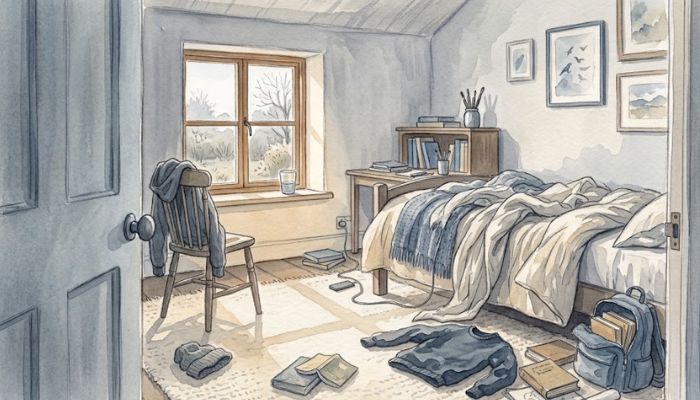
Their rooms are a mess. A jumper on the floor, and a glass on the sill with an inch of water going cloudy. The bed sheets are creased where somebody lay on top of them without getting in. They were here on Saturday, and they will be here again next Saturday.
By most measures you should be a happy man. The door opens once a week and your children walk through it. Plenty of fathers would trade everything they own for that.
They barely speak.
You ask about school and get silence. You ask what they want for dinner, and you get a shrug. The evening passes. They hide in the rooms, and then they leave. Another week.
The mess is the part you cannot bring yourself to clear. It is evidence. Somebody was in this house and the rooms got used.
You keep the house for those two rooms. That is the whole reason. You work, you carry the loan, and most of what you earn goes into an address so that two people who hardly talk to you have somewhere to hide on a Saturday. Some months the question comes before the bill does. Whether any of it is worth what it takes. Whether you are keeping a home or running a hotel for guests who are not even polite to you.
Two rooms, one each. You could have put them in together and used the other for something else. A room shared is somewhere to sit. A room of your own is somewhere you belong. They have a space in this house that is theirs, whether or not they use it for anything besides shutting the door.
A smaller place would cost half of what this one costs. Somewhere with nothing in the walls, no pencil marks on the doorframe. People have suggested it, usually kindly.
You cannot do it. Selling would mean agreeing that the years in this house were a phase that finished, and they did not finish. So you stay. You pay.
Nothing in the house is neutral. You cross the kitchen and something arrives with you, joy and grief in the same movement, most days, and you have stopped waiting for the morning when it will not.
So you hold the space. You cannot make them talk and you cannot undo what was said about you in the years they were small. You can keep two rooms standing ready, and pay for them, and hope that one of these Saturdays a door opens from the inside.
The phrase behind "childless woman in her home" is "aqeret habayit", the barren one of the house. Barren, and of the house. She has the house. She does not have what it was for.
Hannah lived in a house with children in it. They belonged to Peninnah. "Because the Lord had closed Hannah's womb, her rival kept provoking her in order to irritate her. This went on year after year. Whenever Hannah went up to the house of the Lord, her rival provoked her till she wept and would not eat." (1 Samuel 1:6-7)
She walked past those children every day. They were close enough to touch, and that is what made it unbearable.
You can be barren in a house that has your children in it.
You know their birthdays. You know which one likes to read, and which likes to game. You remember the drooling on your shoulder and the joy of yesterday. The love has nowhere to land, and love with nowhere to land does not evaporate. It pools. It sits in a laundry basket and a fridge stocked on a Friday for a Saturday nobody comments on.
"The Lord is exalted over all the nations, his glory above the heavens. Who is like the Lord our God, the One who sits enthroned on high, who stoops down to look on the heavens and the earth?" (Psalm 113:4-6)
He sits so high that the heavens are below him. He has to bend down just to see them. Then he keeps going, past the nations and the palace, out to the ash heap on the edge of the village where the people nobody counts sit in the dust.
"He raises the poor from the dust and lifts the needy from the ash heap." (Psalm 113:7)
Then the house. He comes all the way down to one house, and stops there, and calls that a reason to praise.
Hannah first sang the line the psalm borrows. She got there through years the verse does not show.
Hannah waited years. Scripture gives it one line.
A short sentence does not mean a short road. Hannah's years took as long as years take.
So the honest prayer carries no date. May he find joy. May the silence break.
The psalm never asks you to explain why you keep the house. It tells you where God is looking. His eyes arrive at a shut bedroom door, and a man carrying a cloudy glass down to the kitchen on Monday morning.
He stoops that far. He always has.
The verse settles her in the house first. It calls her a happy mother second. You have the house. You are paying for it every month, and the joy has not come, and nobody can tell you the year it will. Both halves sit in the one sentence. The same hand wrote both.